Guide
LLM SEO: what works and what doesn't
LLM SEO is the work of writing pages that a large language model quotes when it answers a question. It also goes by generative engine optimization and answer engine optimization. The field is young, so most advice is a guess. This guide covers the studies with published numbers: what raised citations, what did nothing, and what to do first.

Key takeaways
- The one controlled test found a 30% to 40% lift from naming sources, adding quotes and adding statistics.[2]
- Keyword stuffing and schema markup did not raise citations in the same tests.[2][3]
- Sources an engine cites overlap only 34% to 42% day to day, so one check cannot separate an actual change from noise.[4]
- Basics still gate everything: Google says a page must be indexed and snippet-eligible to be linked in AI Overviews or AI Mode.[5]
In this article
What does LLM SEO mean?#
LLM SEO means writing pages that a large language model (LLM) can quote when it answers a question. An LLM is the kind of model behind ChatGPT, Claude and Gemini. People also call this work generative engine optimization (GEO), answer engine optimization (AEO) and LLM optimization (LLMO). The names change. The job does not: get a piece of your page inside the answer itself, instead of a link underneath it.
This matters because buyers now ask a chatbot before they search. G2 surveyed 1,076 B2B software buyers and found 51% start research in an AI chatbot more than in Google.[8] A page the model never quotes stays invisible to that buyer. We cover the three names, and how they differ, in what is AEO.
How is LLM SEO different from traditional SEO?#
Traditional SEO earns a rank, and the click follows it. A language model does not rank pages. It picks pieces of pages and writes an answer from them. That changes what matters. Ahrefs found that only 38% of Google AI Overview citations now come from pages in the organic top ten, down from about 76% in July 2025, across 863,000 keywords.[1] Ranking well and getting quoted are no longer the same thing. A page can sit at position one and never appear in an answer, while a page ranked forty gets quoted because it says something the others do not.
The table sets the two side by side. Each LLM SEO cell cites the study it comes from. Where no study covers a row, we say so instead of guessing.
| Question | Traditional SEO | LLM SEO |
|---|---|---|
| What you win | A position in a list of links | A passage inside the generated answer |
| Does a top-ten rank get you there? | It is the goal | Only 38% of Google AI Overview citations come from the organic top ten[1] |
| Entry requirement | Be indexed | Same on Google: indexed and eligible for a snippet[5] |
| Special files or markup | Schema can earn rich results | Google: no special files or schema needed[5]. Ahrefs: no citation lift from schema[3] |
| JavaScript-only content | Google can render it | None of the major AI crawlers Vercel measured render JavaScript[6] |
| Writing tactic with a measured lift | Not covered by these studies | Sources, quotes, statistics: 30% to 40% on one metric[2] |
| Keyword repetition | Not covered by these studies | Little to no help in the GEO test[2] |
| Run-to-run stability | Not covered by these studies | Cited sources overlap 34% to 42% between two days[4] |
Traditional SEO still decides whether you are in the pool at all. LLM SEO decides which passage from the pool gets lifted. For the Google side, see how to rank in AI Overviews. For why engines pick one source over another, see how AI chooses what to cite.
What does the research show works?#
One study tested this directly. Aggarwal and colleagues built a benchmark of 10,000 queries and tried nine writing changes on real page content.[2] The three that worked best were adding source citations, adding quotes from credible people, and adding statistics. They raised visibility by 30% to 40% on one metric (position-adjusted word count, which counts how much of the answer comes from your page and how early) and 15% to 30% on another (a score for how the answer treats your source). A named source, a real quote and a real number are the parts of a page a model can lift out and reuse.
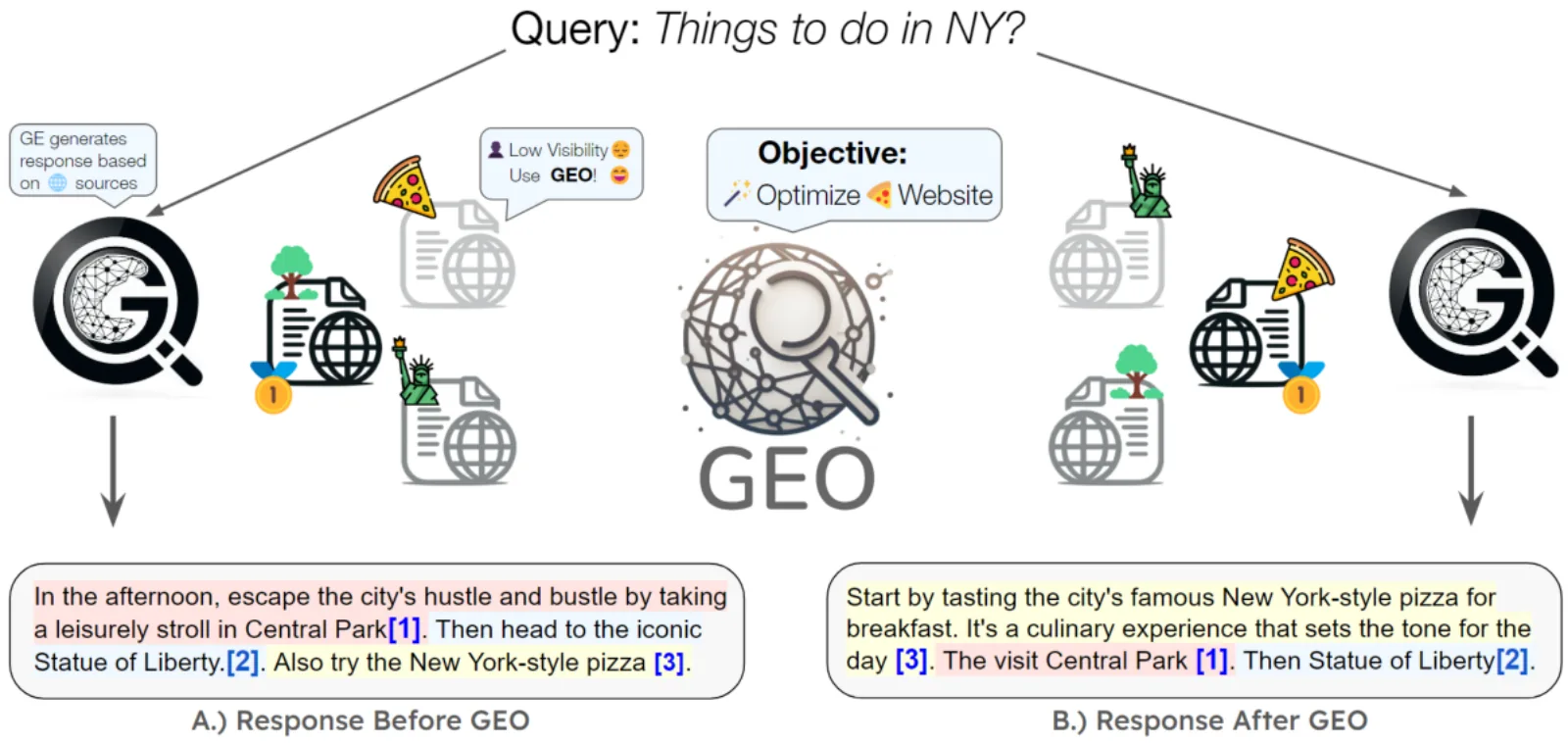
Two more results are worth knowing. Plain writing changes also helped: making text easier to read and smoother raised visibility by 15% to 30%.[2] And the effect was uneven across pages. Adding sources raised visibility for sites ranked fifth in the results by 115.1%, while the top-ranked site lost 30.3% on average.[2] The authors also ran a test on Perplexity, a live engine, and saw gains of up to 37% on one metric.[2] They warn the size of the effect varies by topic, so read these as ranges you can land in, not promises.
| Change tested | Result in the GEO paper |
|---|---|
| Cite sources | 30% to 40% lift on word count metric; +115.1% for rank 5 sites, -30.3% for rank 1[2] |
| Add quotes | 30% to 40% lift on word count metric, 15% to 30% on impression metric[2] |
| Add statistics | 30% to 40% lift on word count metric, 15% to 30% on impression metric[2] |
| Improve fluency, simplify language | 15% to 30% visibility boost[2] |
| Keyword stuffing | Little to no improvement[2] |
A second, observational study looked at 1,100 pages and 1,702 citations across three live engines. Pages with a higher overall quality score were cited at an odds ratio of 4.2, with the strongest links for metadata, freshness and structured data.[7] This study cannot show those signals cause citation, only that they travel together. Treat it as a pointer for what to check, not as a proven lever.
What does not work?#
The same GEO study tested keyword stuffing, using the search words more often on the page. It offered little to no improvement.[2] Schema markup did not help either. Ahrefs tracked 1,885 pages that added schema against about 4,000 pages that did not, from August 2025 to March 2026. Citations barely moved on two engines, and fell 4.6% on Google AI Overviews.[3] The pages in that test were already cited often, so the result may not hold for a page starting from zero. Schema is good hygiene. It does not get you quoted more.
A third thing that fails is hidden text. Vercel measured crawler traffic and found that none of the major AI crawlers it tracked render JavaScript.[6] If your answer appears only after scripts run, those crawlers never see it. This is a free fix for many sites built on script-heavy frameworks, and it is one of the few LLM SEO problems you can check in a minute by viewing the page source.
Does each AI engine read a different index?#
Yes, and that is why one tactic does not give the same result everywhere. An engine can only quote a page its search index already stored. Google runs its own index for AI Overviews and Gemini. ChatGPT search uses outside providers, including Bing. Perplexity built its own index. Claude does not name its provider. The full breakdown, with sources for each engine, is in how AI search engines work. Across 100,000 identical prompts, ChatGPT and Perplexity shared only 11% of their cited sources, so a win on one engine says little about another.[8]
What is the LLM SEO checklist?#
Six steps, in the order we would do them. Each carries its evidence, so you can see which are backed by a study and which are practice.
Get the page indexed and snippet-eligible
Google says a page must be indexed and eligible to show in Search with a snippet to be linked in AI Overviews or AI Mode.[5] Evidence: Google documentation.
Put the answer in plain HTML
Vercel found that none of the major AI crawlers it measured render JavaScript. They fetch JavaScript files but do not run them.[6] Text that appears only after scripts run is not seen by those crawlers. Evidence: crawler log study.
Name your sources, add quotes, add numbers
This is the one tactic set with a controlled result: a lift of 30% to 40% on one metric.[2] Use real, dated figures and name who published them. Evidence: peer-reviewed benchmark.
Answer the question in the first sentence of each section
Each section should answer one question on its own, so a model can lift it without the rest of the page. This is our working practice. We have no controlled study of it, so treat it as a hypothesis.
Skip keyword stuffing and schema as ways to win citations
Neither raised citations in the tests above.[2][3] Keep schema for hygiene and spend the time on step 3.
Measure with repeated runs
Check the same questions several times on each engine, spread over days, before you call a change real.[4]
Why does one check lie to you?#
AI answers change from one day to the next. One study found that the sources an engine cites overlap only 34% to 42% between two days in a row.[4] So a check before and a check after cannot tell an actual change from normal noise. You need repeated checks against the same questions, on each engine, before you trust a number. A handful of runs per question, spread across a week, is a fairer test than one screenshot on one good day. The same logic applies when an agency shows you results: ask how many runs sit behind each number, and read how to verify AI visibility results. If you are still choosing one, start with what an SEO agency does.
Noetio runs these checks for you. We test the questions your buyers ask, across every engine, more than once, so a citation gain shows up because it happened, not because of noise. See our AI SEO services for how the work is scoped, or start with the free check.
FAQ
- What is LLM in SEO?
- LLM SEO is the work of writing pages that a large language model quotes when it answers a question. LLM stands for large language model, the kind of model behind ChatGPT, Claude and Gemini. It is also called generative engine optimization (GEO) or answer engine optimization (AEO). The goal is a quoted passage inside the answer, not only a link under it.
- Which LLM is best for SEO?
- This post does not rank models, because none of the studies we cite tested one model against another for SEO work. The more useful question is which LLMs your buyers use. Check your own questions on each engine before you pick where to spend effort.
- Is SEO dead now with AI?
- No. Google says a page must be indexed and eligible to show in Search with a snippet to appear as a supporting link in AI Overviews or AI Mode. But ranking is not enough: Ahrefs found only 38% of AI Overview citations come from pages in the organic top ten. SEO is the entry ticket, not the whole job.
- Does schema markup help LLM SEO?
- Not in the tests we found. Google says no special schema.org structured data is needed for AI Overviews or AI Mode. An Ahrefs comparison of 1,885 pages that added schema against about 4,000 that did not found no lift on two engines and a 4.6% drop on Google AI Overviews.
- Is LLM SEO the same as GEO and AEO?
- In practice, yes. GEO comes from a 2023 research paper, AEO is an older term from the featured snippet era, and LLM SEO is the label many searchers use now. Vendors sell all three as one job: getting quoted by a system that reads web pages and writes an answer.
- Who is the best LLM SEO expert?
- We cannot name one, and no public benchmark ranks LLM SEO experts. Ask any expert for a controlled test with a comparison group and repeated runs, and for the effect size they measured. A before and after screenshot is not evidence.
Want to know which of your pages AI engines already quote?
Sources
- Ahrefs, “38% of AI Overview Citations Pull From The Top 10”, 863K keyword SERPs, 4M AI Overview URLs, March 2026. Vendor study. The chart uses its organic blue-link split (37.1%, 26.2%, 36.7%).
- Aggarwal et al., “GEO: Generative Engine Optimization”, arXiv:2311.09735, KDD 2024. 10,000 queries (GEO-bench). Designed experiment with per tactic effect sizes, plus a test on Perplexity.
- Ahrefs, “We Tracked 1,885 Pages Adding Schema”, matched comparison against about 4,000 controls, August 2025 to March 2026. Vendor study, disclosed method.
- “Don't Measure Once: Measuring Visibility in AI Search”, arXiv:2604.07585. Shows single run measurement of AI visibility is unreliable.
- Google Search Central, “AI features and your website”. Official documentation, read 2026-10-03.
- Vercel, “The rise of the AI crawler”. Server log analysis: 569 million GPTBot and 370 million Claude fetches, none rendering JavaScript.
- GEO-16 framework, arXiv:2509.10762. 70 prompts, 1,702 citations, 1,100 URLs, three production engines. Observational.
- G2, “The Answer Economy”. 1,076 B2B software buyers, surveyed March 2026. The 11% ChatGPT and Perplexity overlap is from Profound, 100,000 prompts, July 2025.
Each claim names its source, sample size and method. Papers, vendor studies with a disclosed method, and Google documentation, linked directly.
If you want this done for you