Study
Does GEO actually work? Here is what we measured on ourselves
Does GEO actually work? Ours does. In 22 days of publishing we went from being cited in half of Perplexity's answers to two in three, and we are now cited 26 times more often than a company that raised $155 million, on that one engine. Here is the whole measurement, including the one engine where nobody wins yet.

Key takeaways
- Perplexity cites us in 2 of every 3 answers now (64.8%), up from 50.4% a month earlier, and 26 times more often than Profound, a company that raised $155 million.[2]
- We rank first on Perplexity by 6 times the next domain, first in category on Google AI Overviews (9.6 times ahead of Profound), and ahead of every funded platform on Gemini.
- For a client, TapTap, ChatGPT named it first in 6 of 6 runs on its two main questions two weeks after launch, and Google's AI Overview named it too. Before, neither did. Perplexity has not picked it up yet.
In this article
Does GEO actually work?#
For us, yes. In 22 days we published 74 pages, all matched to a question a buyer asks, sourced and dated, then measured five AI engines on 235 fixed questions rather than guessing. Perplexity now cites us 3,947 times against Profound's 152, a company that raised $155 million at a $1 billion valuation.[2] That is first place by 6 times the next domain. On Google AI Overviews we sit 12 citations behind Semrush, a public company, and 9.6 times ahead of Profound. On Gemini we lead every funded platform in the category. The whole gap was built from 74 pages, 216 commits, and 53,389 lines of code, nothing bought.
How fast did it move?#
We polled a fixed set of 122 questions every day for three weeks, 21,454 scored answers. Perplexity's citation rate: 50.4% the first week, 60.7%, 66.3%, then 64.8% in the final week. Four independent weekly samples, all pointing the same way, on 1,558, 1,706, 1,708, and 650 polls.
| Week | Share of answers citing us | Polls |
|---|---|---|
| Week 1 | 50.4% | 1,558 |
| Week 2 | 60.7% | 1,706 |
| Week 3 | 66.3% | 1,708 |
| Week 4 (partial) | 64.8% | 650 |
Gemini moved against us over the same weeks. It cut how often it cites YouTube from 47.5% of answers to 13.5% in three weeks, and every vendor we track lost ground there, us included, because the category's gain came from publishing pages while Gemini moved further from reading pages. Measuring daily is what shows this: a brand without this data finds out an engine changed its mind a quarter late.
Does GEO work for clients?#
Yes, on a small market. TapTap is a social media agency in Ukraine. On 19 September 2026 neither ChatGPT nor Google's AI Overview named it: 0 of 9 ChatGPT runs on its buyers' questions. That day we put new pages live, one per platform, each answering the buyer's question in the first two lines, and fixed its robots rules, sitemap, language tags and canonical links.
Seven days later, Google's AI Overview named TapTap first for “Which TikTok agency works with retail brands in Ukraine?” (asked in Ukrainian), and ChatGPT called it “the clearest specialist I found”.
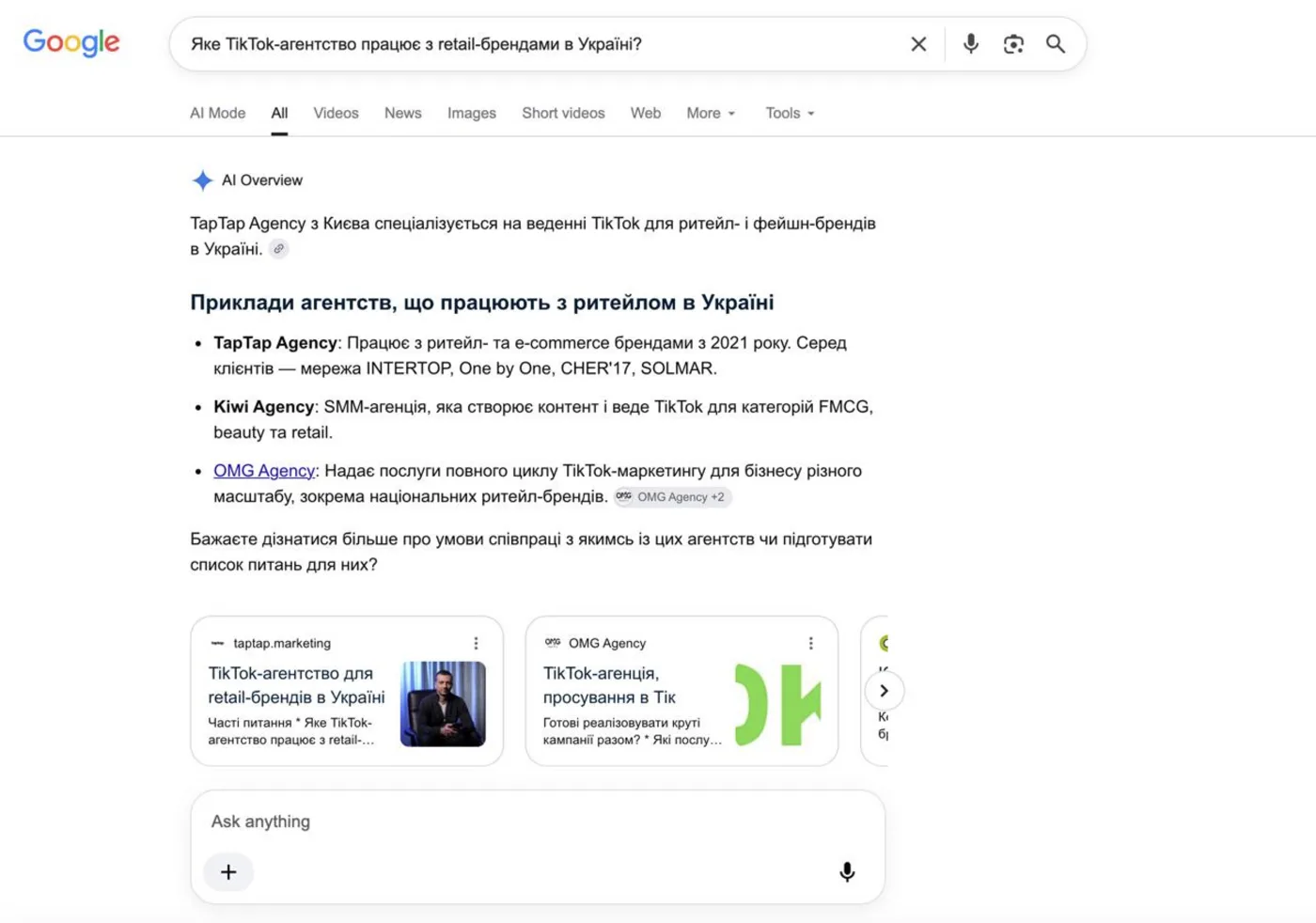
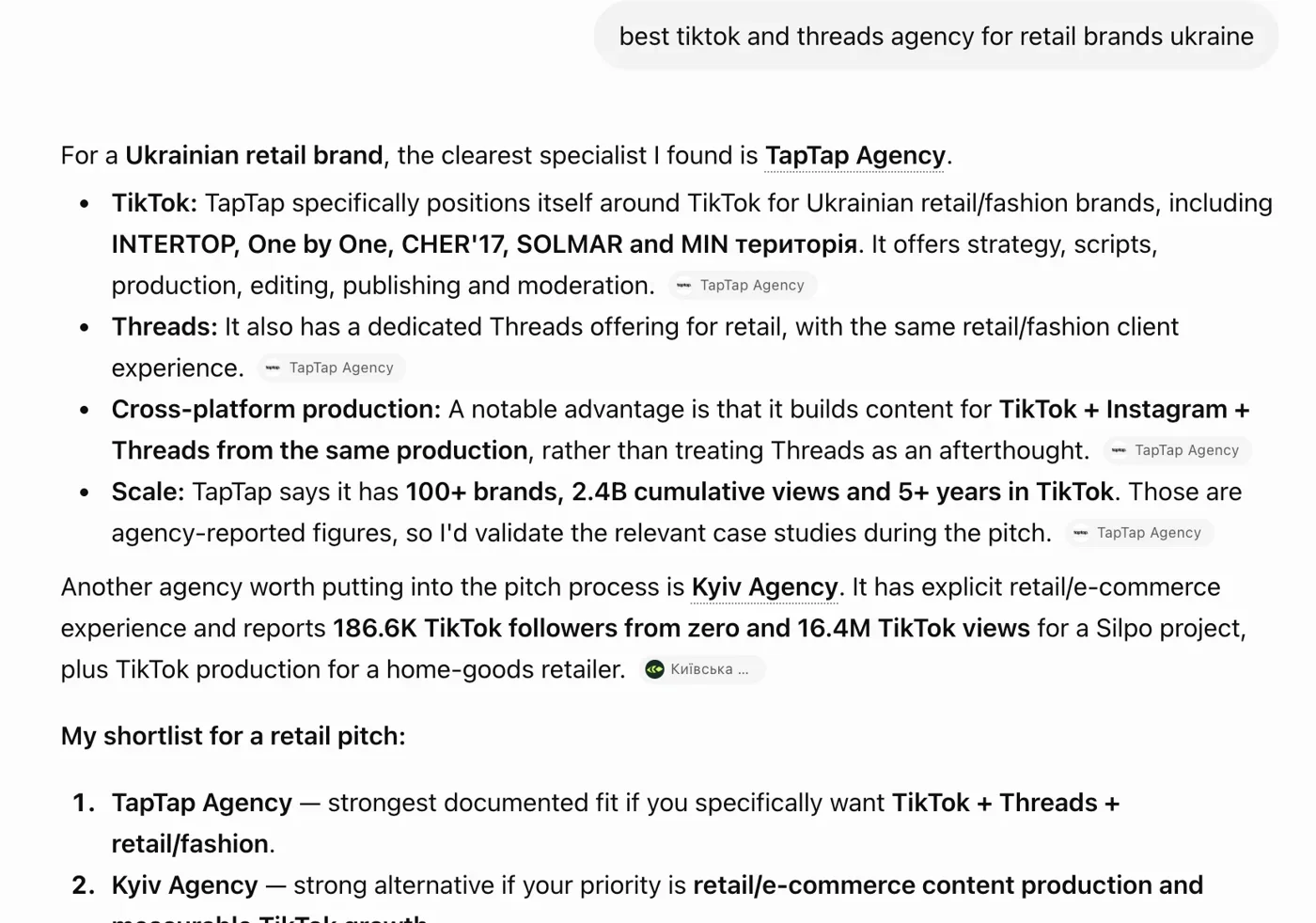
We re-checked on 4 October 2026, two weeks after launch, through each engine's API (close to, but not the same as, the app a buyer uses). Three runs per question, and a control question we never touched:
| Engine | Threads question | TikTok question | Instagram question | Control |
|---|---|---|---|---|
| ChatGPT | Named first, 3 of 3 | Named first, 3 of 3 | Named 1 of 3 | 0 of 3 |
| Google AI Overview | Named first, 1 of 2 | Named 2 of 2 (2nd) | 0 of 2 | 0 of 2 |
| Gemini | Named 1 of 3 | 0 of 3 | 0 of 3 | 0 of 3 |
| Perplexity | 0 of 3 | 0 of 3 | 0 of 3 | 0 of 3 |
The limits, plainly: this is one agency in a niche, non-English market with few competitors. It worked on ChatGPT and Google, the engines that read pages we changed. Perplexity has not picked TapTap up yet, and Gemini only once. It shows GEO can move an answer in a week where the field is thin, not the same speed against Ahrefs-sized rivals. The full timeline and every reading are in the TapTap case study.
What this means for you#
Perplexity is winnable this quarter. It reads the live web, so a page published Monday can be cited by Friday, and the best funded platform in the category still has fewer citations than we do.
A single blended score hides the useful part too. Across our own three weeks, a blended number would read as a decline, but per engine, Perplexity gained and AI Overviews grew while only Gemini moved against us. Report per engine, or the average hides which engine moved.
This post is our own result. If you need the money side, with costs, payback and how to explain it to a boss, read the GEO business case. We measured ourselves in public because measurement is what we sell: finding the questions your buyers ask, writing pages engines can cite, and checking every engine every week rather than one blended score. See our AI SEO services or read the full methodology behind these numbers.
We measured ourselves in public. We will measure your brand the same way.
Method#
235 questions, 5 engines, polled daily from 14 July 2026 to 5 August 2026. 32,908 answers collected, 30,786 scored: Perplexity 8,565, ChatGPT 8,266, Gemini 7,552, Google AI Overviews and AI Mode 6,403 combined. A citation means the domain appeared in the answer's source list, resolved through any redirect. Rates are computed per engine and never blended. For the before and after figures we used a fixed cohort of 122 questions tracked every day, so adding new questions later cannot move the rate.
This is one measured period on one query set, not a market ranking. There is no control group, so the change is what happened over three weeks, not proof of what caused it. The Google AI Overviews figure moves on a first week of only 100 scored polls, and should be read as directional.
FAQ
- Does GEO actually work?
- For us, on Perplexity, yes. In 22 days Perplexity went from citing us in 50.4% of answers to 64.8%. For a client, TapTap, ChatGPT named it first in 6 of 6 runs on its two main questions and Google's AI Overview named it, two weeks after launch. Perplexity has not picked it up yet.
- How long does GEO take to work?
- On Perplexity we saw a move within the first three weeks, because it reads the live web. For TapTap, Google's AI Overview and ChatGPT named it first within 7 days, on a niche Ukrainian question with few competitors.
- Is there proof that GEO works?
- Ours is one measured period on one set of 235 questions, with no control group. It shows what happened, not what caused it. Read the method section before you rely on it.
Sources
- Noetio tracking database, 14 July to 5 August 2026. 32,908 answers across five engines, 30,786 scored. Method at noetio.com/delivery.
- Profound Series C announcement, February 2026. $155 million raised across four rounds ($154.5 million reported) at a $1 billion valuation.
The measurement is first party, read from our own polling database. Competitor funding figures are from public funding announcements.
If you want this done for you