Guide
How to verify AI visibility agency results, in four asks
How to verify AI visibility agency results comes down to four asks: the exact prompts they track, how many times each was run, results for each engine, and the full answers behind every score. Ask for all four before you trust a single number.

Key takeaways
- Demand four things: the exact prompts, how many times each was run, results per engine, and the full answers behind every score.
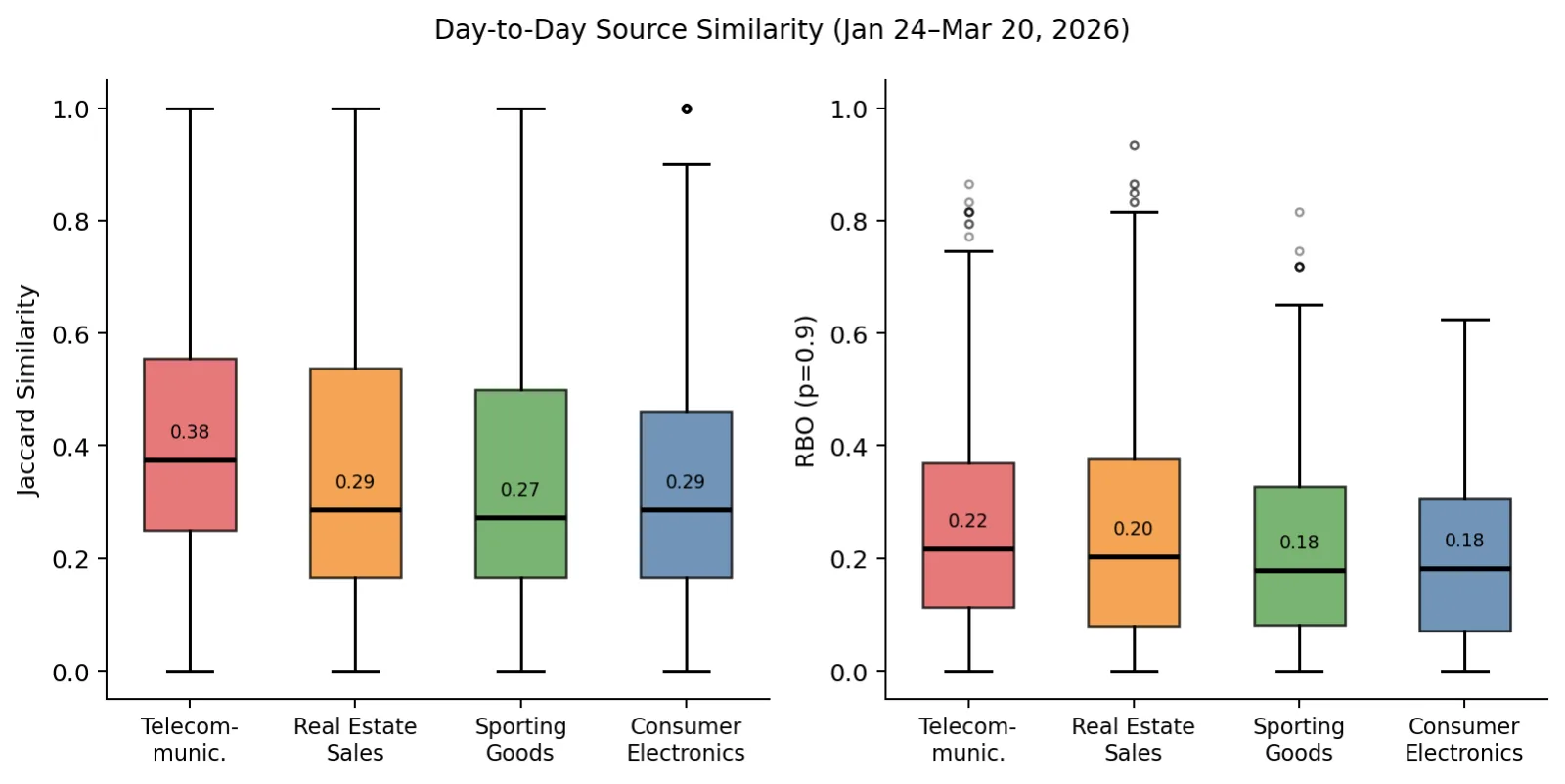
- The sources an engine cites overlap only 34 to 42% between two days with nothing changed.[1] One screenshot cannot tell work from noise.
- A percentage with no "how many times we ran it" attached is not a result. It is a single reading.
In this article
What an agency must show you#
Four artifacts turn a claim into something you can check. Ask for all of them before you sign. New to hiring one? Start with what an SEO agency is and what it does.
The exact prompts, fixed up front
Which buyer questions are tracked, fixed before work starts. A prompt set that changes mid engagement makes before and after impossible to compare.
How many times each was run
Not “we check regularly”. A number, per prompt, per engine. Repeats are what separate signal from noise: the sources an engine cites overlap only 34 to 42% between two days with nothing changed.[1]
Results for each engine
Never one blended score. In our own study one brand hit 100% on Gemini and 90% on Perplexity, while another sat at 70% on ChatGPT and 40% on both.[3] A blended number hides exactly the gap you would act on.
The full answers
Date and time, engine, full answer text, cited sources, and whether the check failed, for every prompt. A score with no answers behind it cannot be checked at all.
| Ask | A good answer | A bad answer |
|---|---|---|
| Exact prompts | A list, fixed before work starts | "We track your key topics" |
| Times each was run | A number per prompt and engine | "We check regularly" |
| Results per engine | ChatGPT, Gemini, Perplexity shown apart | One blended score |
| Full answers | Date, engine, answer text, cited sources | A screenshot of one chat |
Which numbers mean something?#
Three words get used for one thing, and they are not the same. Mentioned means the brand name showed up in the text. Cited means the brand's own page showed up in the sources. Recommended means the answer put the brand forward. Ask which one moved: a mention with no citation sends no traffic, and a citation with no recommendation wins no deal. Ask for a confidence interval too. Ten checks and a hundred checks can show the same percentage with very different certainty behind it.
What weak reporting looks like#
A percentage with no count
“Visibility up 40%” means nothing without the number of prompts, how many times each was run, and the engine behind it.
A screenshot of one chat
One answer is one sample from a set that turns over daily. It proves the answer existed once.
A score that only ever rises
Good tracking has down weeks. Ours did: Perplexity citations ran 50.4%, 60.7%, 66.3%, then eased to 64.8% in the last bucket.[4] A line with no dips is curated, not measured.
How do you check their claims yourself?#
Take three to five prompts from their fixed list and run each one yourself, several times, with memory off, on the engines they claim to have moved. You are checking whether the rate they reported is close to the rate you see, not whether the brand shows up once. If they claim seven in ten and you get zero in ten, that gap is the finding. The controlled study behind most GEO advice tested nine methods and found the top three, citing sources, adding quotes, adding statistics, produced a 30 to 40% lift.[2] Most other advice is only a correlation, and should be sold as one. Keep your own runs as evidence, with dates, and repeat the check a month later on the same prompts.
We report how many times each prompt was run, and results per engine, with every score, and we keep the full answer text of every check, so a claim about your brand can be checked the same way. Our AI SEO services also leave half your questions untouched as a control and rerun both halves at day 30. See our methodology or run the free check and read the answers behind your score.
Not sure what to pay for this work? See GEO agency cost. Want an example of reporting with dips and limits left in? Read does GEO actually work.
Want a measurement you can check? Ours ships with the check counts attached.
FAQ
- How do I verify an AI visibility agency's results?
- Ask for four things: the exact prompts they track, how many times each was run, results for each engine, and the full answers. Then run three to five prompts yourself, several times each, and compare.
- Why can't I trust one screenshot of ChatGPT?
- AI answers change from day to day. One study found the sources an engine cites overlap only 34 to 42% between two days with nothing changed. A screenshot shows one sample.
- What should an AI visibility report include?
- The prompt list, how many times each prompt was run, results for each engine (not one blended score), the full answers, and a confidence range.
- What are red flags in AI visibility reporting?
- A percentage with no counts, a screenshot of one chat, a score that only ever goes up, and one blended score across engines.
Sources
- “Don't Measure Once: Measuring Visibility in AI Search” , arXiv:2604.07585. Source sets overlap 34 to 42% between two days, brand sets 45 to 59%; visibility should be treated as a distribution.
- Aggarwal et al., “GEO: Generative Engine Optimization”, arXiv:2311.09735, KDD 2024. Nine methods on a 10,000 query benchmark drawn from 25 domains; top three at 30 to 40% relative improvement on Position-Adjusted Word Count.
- Noetio CRM AI Visibility study, 20 brands, 60 queries across ChatGPT, Gemini and Perplexity, 50 search grounded and scored, August 2026. Per engine rates and the validity note are published with it.
- Noetio own domain citation study, a fixed 122 question set tracked on noetio.com from 2026-07-14 to 2026-08-05, weeks starting 13 Jul, 20 Jul, 27 Jul and 3 Aug. The final week is a partial bucket, 650 runs against roughly 1,700 in each of the first three. No control group.
Two papers with disclosed method, plus our own study, whose dataset and validity note are published alongside it.
If you want this done for you