Guide
GEO pricing: what 17 GEO tools and agencies charge
GEO pricing (the cost of getting AI engines to name your company) is rarely published. Tools list $17 to $800 a month, one enterprise SEO platform starts at $2,500, and almost every GEO agency quotes only on a call. We checked the pricing pages of seventeen vendors on 3 October 2026.

Key takeaways
- Tools list $17 to $800 a month. Eight of the 17 vendors we checked publish no price for their AI product.[1]
- Almost no agency publishes a retainer price. Every one we checked quotes only on a call.
- A single check a month proves nothing: the pages AI engines cite overlap only 34% to 42% between two days in a row.[2]
In this article
What do GEO tools and platforms charge?#
These are the prices vendors show on their own pricing pages, checked on 3 October 2026.[1] They are monitoring tools, not agencies, which matters for the next section. If you are choosing a tool, see our vendor comparisons.
| Vendor | Entry price shown | What you get at that price |
|---|---|---|
| Rankscale | $17 a month, billed yearly | Essentials plan |
| Otterly AI | $29 a month | Lite, 15 prompts. Standard is $189 (100 prompts), Premium $489 |
| Similarweb AI Visibility | $99 a month billed yearly ($129 monthly) | AI visibility tracking |
| Semrush AI Visibility Toolkit | EUR 94.94 a month per domain, billed yearly | Shown in euros to our checker |
| Scrunch | $250 a month | Core, 125 prompts, 4 AI engines |
| Athena HQ | $295 a month | Starter, 11 AI models. A free tier exists |
| Goodie AI | $399 a month | Core, 120 prompts |
| Evertune | $800 a month | Pro plan |
| seoClarity | $2,500 a month | Base SEO platform. The AI product (ArcAI) has no public price |
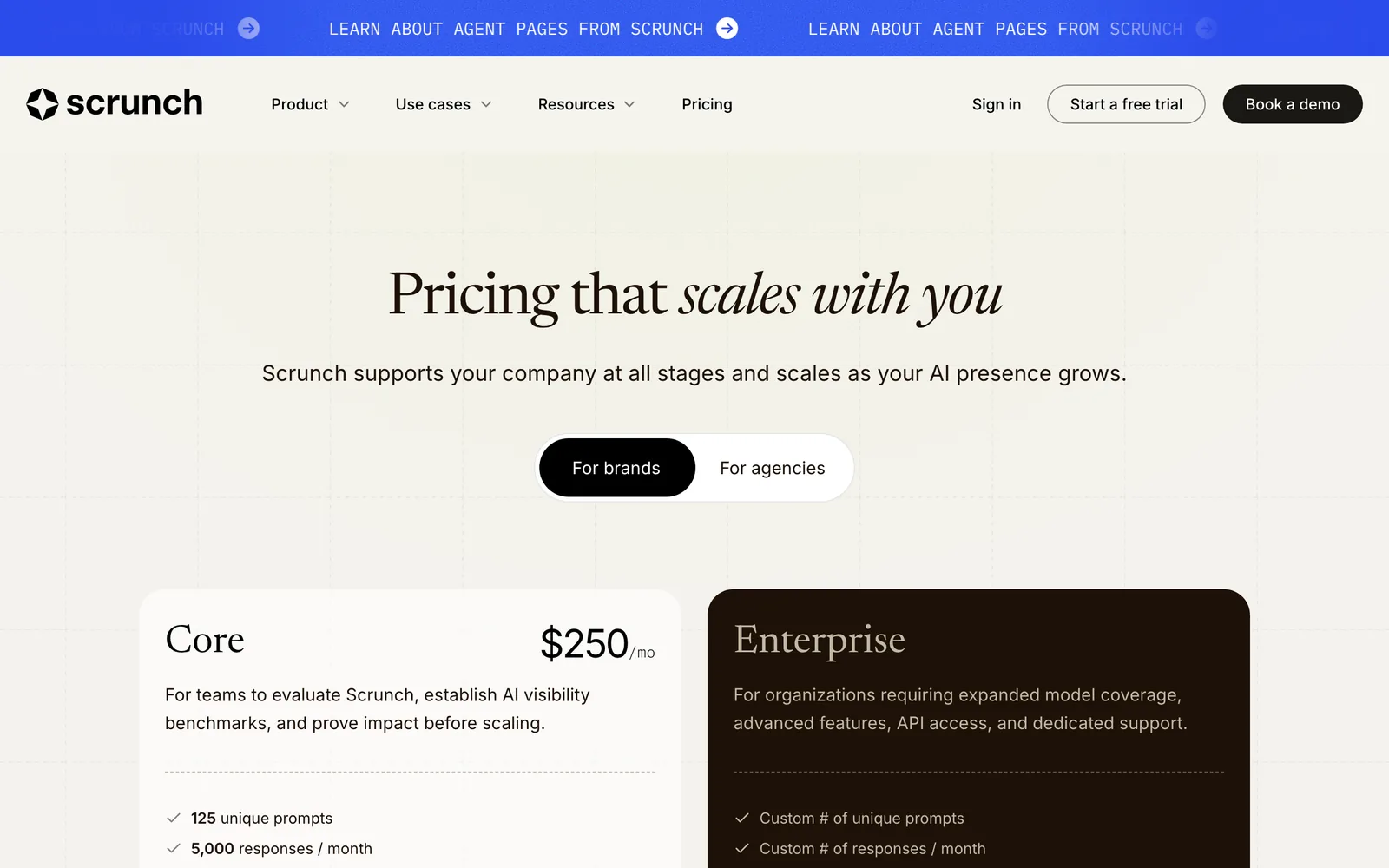
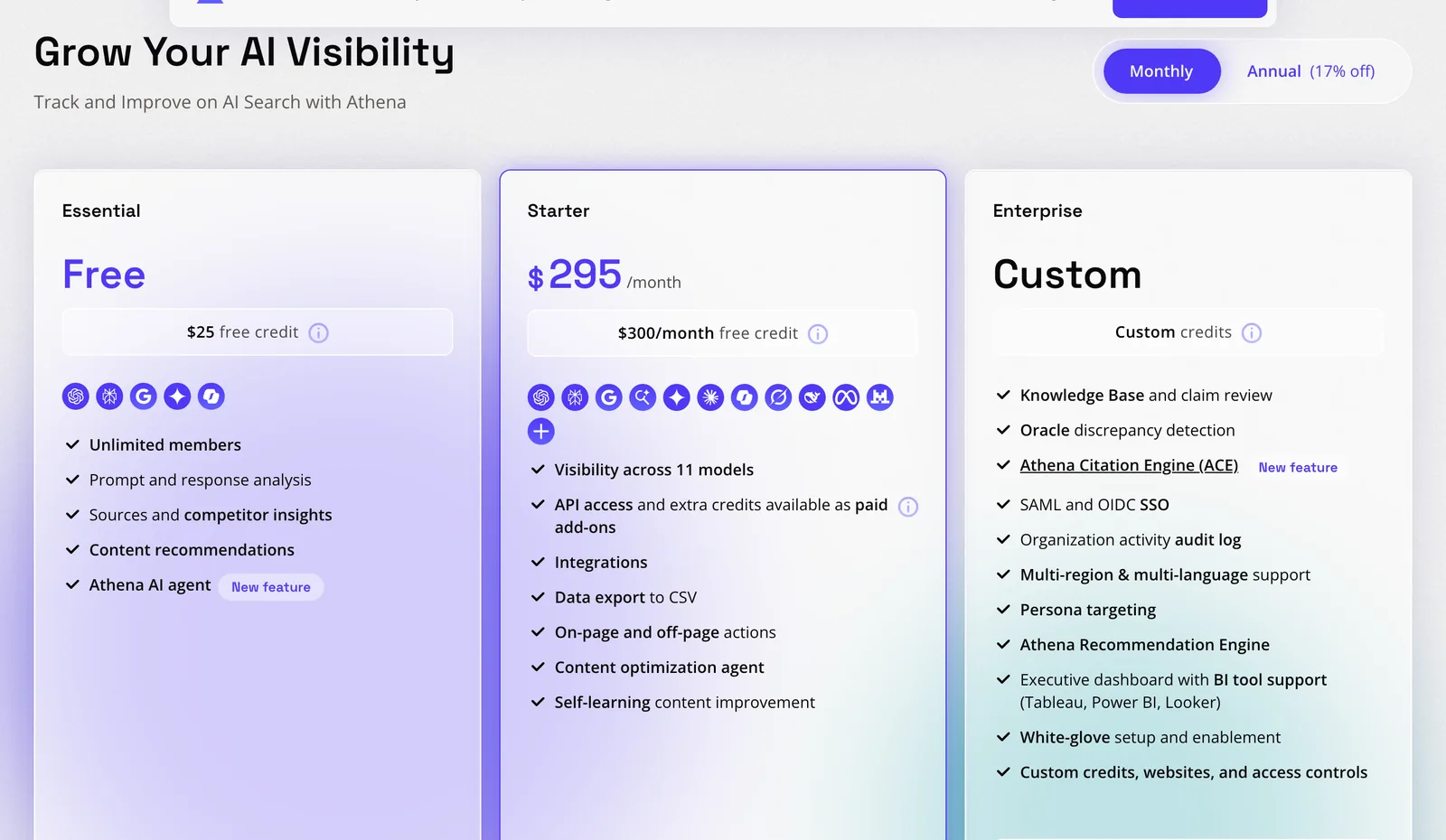
Ahrefs Brand Radar showed GBP 40 a month for custom prompts when we checked, so we left it out of the dollar table. Eight vendors show no price for their AI product: Profound (free 7-day trial, paid plans custom), Peec AI, BrandRank.AI, Bluefish AI, Daydream, BrightEdge, Conductor and seoClarity's ArcAI. Peec showed no dollar amounts on its page this time; its July prices were $95, $245 and $495.
Why does agency pricing stay private?#
Every price above is software. Search for GEO agency pricing and you mostly find nothing, because scope moves the number: how many buyer questions, how many AI engines, and whether anyone writes and ships the fixes or hands you a list. That is a fair reason. It is also a convenient one, since it makes a quote hard to compare. So compare what arrives instead of the number. Ask these four questions before you sign anything. For the plain SEO version of this question, see what an SEO agency is and how it charges.
The list of buyer questions, and who owns it
Which buyer questions get tracked, how many, and whether you keep the list if you leave. A retainer measured on questions you cannot see cannot be checked.
How often each question is checked
One check a month tells you nothing. Ask how many times each question is checked per engine, and whether they publish it.
Who ships the fixes
Most of the category delivers a dashboard and a list. If the retainer does not name who writes the pages and puts them live, you are buying measurement.
Off-page work
Across 25 million links, 84% of AI citations were earned media and 0.3% paid, not the brand's own site.[3] A retainer that only touches your own pages is working part of the surface.
Agencies also sell the work, not just the tracking. For what that work is, see what an SEO agency is and our AI SEO services.
GEO instead of SEO, or as well?#
As well, and the reason is measurable, not rhetorical. Only 12% of the URLs cited by ChatGPT, Gemini and Copilot rank in Google's top ten for the same prompt, across a 15,000 prompt dataset.[4]Ranking and being cited have come apart far enough that one does not stand in for the other. So “my SEO is already good, do I need this” has an answer: a strong Google position is not proof of AI visibility, in either direction. The cheapest way to find out is to ask the engines your own category's questions and count.
How long before GEO agency cost pays off?#
Longer than a dashboard makes it look. For the evidence on results, see does GEO work. The sources an engine cites overlap only 34% to 42% between two days in a row,[2] so two weeks of checks can show a swing that nothing on your site caused. Treat any promised result inside a month as noise, not signal. What a competent engagement can show early is input: pages shipped, rendering fixed, coverage placed. The outcome, a change in how often engines cite you across repeated checks, shows up later. The clearest way to report it is per engine, with the number of checks shown.
Noetio scopes this work on a call instead of guessing at one number that fits every company. We find the questions your buyers ask, track them across every engine with repeated checks, and ship the pages and mentions that earn a citation. Run the free check to see where you stand today.
Want your category's number? We scope it on a call.
FAQ
- How much does a GEO agency cost?
- Almost no GEO agency publishes a price; every one we checked quotes on a call. The only public prices are for tools: $17 to $800 a month for the plans we found, and an enterprise SEO platform from $2,500 a month.
- What does GEO software cost?
- From $17 a month (Rankscale, billed yearly) and $29 (Otterly Lite) to $800 (Evertune Pro), checked on 3 October 2026. Eight of 17 vendors publish no price for their AI product.
- Is GEO worth the cost?
- Rankings and AI citations have come apart: only 12% of URLs cited by ChatGPT, Gemini and Copilot rank in Google's top ten for the same prompt. Good SEO alone does not prove you are visible in AI answers.
- Do I need GEO if my SEO is good?
- Yes, check it. Ask the AI engines your category's questions and count how often you are named. That costs nothing.
- How long does GEO take to show results?
- Longer than a dashboard suggests. Cited sources overlap only 34% to 42% between two days in a row, so early swings can be noise. Treat any promised result inside a month with doubt.
Sources
- Noetio vendor comparison pagesand the vendors' own pricing pages (for example Otterly, Scrunch, Athena HQ). 17 AI visibility tools, prices checked 2026-10-03.
- “Don't Measure Once: Measuring Visibility in AI Search” , arXiv:2604.07585, 2026. Source sets overlap 34% to 42% between two days in a row.
- Muck Rack, Generative Pulse, May 2026. 25M+ links cited by ChatGPT, Gemini and Claude; 84% earned media, 0.3% paid.
- Ahrefs, “Only 12% of AI Cited URLs Rank in Google's Top 10” , 15,000 prompts across ChatGPT, Gemini and Copilot, August 2025.
The pricing figures are our own audit of published vendor pages, checked on 3 October 2026. The research claims link to the studies they rest on.
If you want this done for you