Guide
GEO ROI and business case: the numbers that hold up
GEO ROI and the business case for it: does the evidence hold up? Yes. Buyers already ask AI before Google, traffic from AI answers converts better, and enterprises are already spending and hiring for it. We traced every widely cited number in this category back to its source and kept only what survived. This is the case for spending. For our own measured results, see does GEO actually work.

Key takeaways
- 51% of B2B software buyers now start research with an AI chatbot more often than Google, up from 29% a year earlier, and 69% switched vendors on chatbot guidance.[1]
- Traffic from AI answers converts 54% higher than other traffic on US retail sites, and enterprises already put 12% of digital budget into this.[5][8]
- Optimization measurably works, up to 40% visibility lift in the founding research, but three of the most quoted GEO statistics, including Gartner's 25% search decline prediction, fail verification.[18][20]
In this article
Buyers moved first, and the traffic converts better#
Buyers already changed channel, and separate data on what that traffic is worth agrees.
B2B buyers switched to AI first
G2 surveyed 1,076 B2B software buyers in March 2026: 51% now start product research with an AI chatbot more often than Google, up from 29% a year earlier; 69% picked a different vendor than planned on chatbot guidance; one in three bought from a vendor they had never heard of before.[1]
It is not only B2B
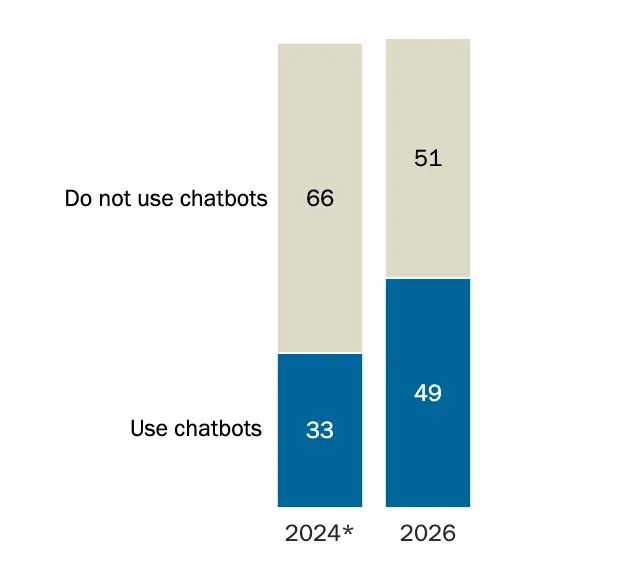
Pew Research: 49% of US adults now use AI chatbots, up from 33% in summer 2024, and 60% read the AI summary at the top of search results.[2] Semrush: 92% of 643 US B2B professionals said AI shaped their vendor shortlist.[3] Forrester: 94% of B2B buyers used AI somewhere in their most recent purchase.[4] Four studies, four methods, one direction.
That traffic converts better
Adobe Analytics watched over a trillion visits to US retail sites: AI referred visitors convert 54% higher than other visitors, reversed from a year earlier when the same feed showed AI traffic converting worse than average.[5]
Two more measures agree
Similarweb: ChatGPT referral traffic converts at 7.1%, second only to paid search's 7.8%, and referrals jumped 157.7% in a week once ChatGPT started rendering clickable brand links.[6] Seer Interactive, 5.5 million queries: being cited inside an AI Overview roughly doubles clicks per impression; ranking organically under an Overview you are absent from cuts clickthrough by about a third.[7]
The engine shortlists before the click happens. A visitor who arrives from an AI answer has already been told you are the answer, which is why this traffic converts like paid search you did not pay for.
The budget already moved, quietly#
Enterprises already spend on it
Conductor surveyed 250+ leaders at 500+ employee companies: 12% of digital budget already goes to answer engine optimization, and 94% plan to increase it in 2026.[8]
Payroll confirms it
Citizens Bank is hiring an Answer Engine Optimization Manager at $131K to $171K base. AWS, Home Depot, JPMorgan Chase, Capital One, Vanguard, Palo Alto Networks and Texas Instruments all have GEO or AEO titled roles open.[9]
Agencies are building GEO practices
Dentsu launched a formal GEO consulting service.[10] Publicis shipped an agentic GEO offering through Performics and Sapient.[11]
So is the acquisition money
Profound raised $96M at a $1B valuation with Fortune 500 logos on its customer page.[12] Sitecore paid a reported $225M for the GEO startup Scrunch.[13] Adobe bought Semrush and shipped AI brand visibility as a native enterprise feature.[14]
Companies do not create titled headcount, or pay nine figures, for trends they consider hype.
What doing it in house takes#
The hard part of GEO is not secret knowledge. The playbook is public, and the talent gap is a time lag, mostly senior SEOs reskilling into this. The durable problem of doing it in house is operational, and it has three layers.
One measurement is worthless. AI engines answer the same question differently every time. Peer reviewed work on measuring AI visibility finds you need repeated runs per query, roughly seven or more, with confidence intervals, per engine, before per brand estimates stabilize.[15] Checking ChatGPT once a week by hand tells you close to nothing.
The engines that matter are several, not one, and they cite almost entirely different sources, so each needs its own tracking. Google's free Search Console data now covers its own AI surfaces,[16]which is useful and covers exactly one vendor's engines.
The ground moves without notice. When ChatGPT swapped models on May 23, 2026, SISTRIX measured 47% of citation share in German language answers changing hands within 48 hours; Indeed lost 47% of its citations, Expedia lost 60%.[17] No changelog, no announcement, found only by vendors running continuous measurement.
Our AI SEO services run those three layers for you, with repeated runs on five engines, each reported separately.
Does optimization work, and what happens at scale#
The founding academic result says yes: Aggarwal et al. measured up to 40% visibility gains from changes as plain as adding concrete statistics, quotable sentences and citations, across a 10,000 query benchmark.[18]Profound's published Ramp case study shows AI visibility on one page family going from 3.2% to 22.2% in a month.[19] These changes work.
Now the part vendors skip. An AI answer has roughly ten citation slots, so visibility is largely a share of a fixed pie: a gain for one page is usually a loss for another.[18] If every brand in a category optimized equally well tomorrow, the gains would cancel. It stays worth paying for anyway, for the same two reasons that sustain paid and organic search: execution quality never equalizes, and once you hold a slot, the spend flips from offense to defense. Consideration sets in AI answers are sticky too: a stable few brands keep their slots across runs while everyone else rotates or never appears. Claiming a slot while a category still sleeps is cheap. Displacing an incumbent after it wakes up is not.
GEO ROI evidence at a glance#
We found no audited GEO ROI figure we would put in a budget. What exists is evidence for each part of the case. Use it to build your own ROI estimate from your own traffic and close rate.
| Part of the case | Finding | Source |
|---|---|---|
| Buyers use AI first | 51% of B2B software buyers start with an AI chatbot | G2, March 2026 |
| Traffic is worth more | AI-referred visitors convert 54% higher on US retail sites | Adobe Analytics, via Digital Commerce 360 |
| Being cited pays | A citation inside an AI Overview roughly doubles clicks per impression | Seer Interactive, April 2026 |
| Companies already spend | 12% of digital budget goes to AEO; 94% plan to raise it | Conductor (vendor survey), April 2026 |
| Changes work | Up to 40% visibility lift from statistics, quotes and citations | Aggarwal et al., KDD 2024 |
| Do not rely on this | Gartner's 25% search drop by 2026 failed to appear on that timeline | Gartner 2024; Search Engine Journal |
To turn this into a number: take your monthly visits from AI engines, multiply by your normal close rate, then by your average deal value. Compare that with the cost of the work. Our GEO agency cost guide covers the cost side.
The numbers we refused to use#
A business case is only as good as its worst citation. Three examples we threw out, so you know what the filter caught.
“Search volume will drop 25% by 2026”
Gartner's February 2024 prediction is probably the most quoted line in GEO sales decks.[20] It has not happened on that timeline: Google still holds over 90% of search share in mid 2026, a different measure than the query volume Gartner forecast, and the prediction drew methodological criticism the week it published.[21]
“Enterprise GEO contracts average $185,000 a year”
This circulates with a precise looking service breakdown, attributed to vendor blogs. We fetched the pages it supposedly comes from. The figure is on neither. It looks like a fabricated statistic that AI summaries keep repeating into new articles.
McKinsey's trillion dollar projections
Widely quoted AI search revenue figures attributed to McKinsey trace only to secondary blog aggregations; we could not locate a primary McKinsey report containing them, so they are not here. McKinsey's actual 2026 CMO survey ranks AI seventeenth on the priority list.[22]
Noetio publishes its own measurement method for the same reason it checked everyone else's: this category's biggest credibility problem is unverifiable numbers, from tools that disagree with each other on identical prompts. See the measurement methodology, or run the free check to see where your brand stands with confidence intervals attached.
Want the same standard applied to your brand? See what AI says about you, with confidence intervals, in 60 seconds.
FAQ
- What is the ROI of GEO?
- We know of no audited, public GEO ROI figure, and we did not use the ones that failed verification. The evidence shows buyers use AI first and AI-referred traffic converts better. Your ROI depends on your own traffic, close rate and deal size.
- Is GEO worth it for a small business?
- It can be, if your buyers ask AI before they buy. Check first whether AI names you today. Our free check shows that. The cost of doing it in house is mostly time spent measuring repeatedly.
- Does GEO replace SEO?
- No. Most AI engines read the live web, so pages that rank and are well sourced help both. They are different jobs, but the work overlaps.
- Which GEO statistics should I not trust?
- Gartner's 25% search drop by 2026, an unsourced $185,000 average enterprise contract, and trillion dollar McKinsey projections. We explain each one above.
Sources
- 51% of B2B buyers start research with AI more often than Google (was 29% in 2025); 69% switched vendors on chatbot guidance; 1 in 3 bought from a previously unknown vendor (n=1,076, fielded March 2026): G2, “The Answer Economy”, April 2026.
- 49% of US adults use AI chatbots (33% in summer 2024); 60% read AI summaries in search (n=5,119, fielded February 2026): Pew Research Center, June 2026.
- 92% of B2B professionals say AI shaped their vendor shortlist; 83% say it influenced the final decision (n=643): Semrush, 2026.
- 94% of B2B buyers used generative AI during their most recent purchase: Forrester, The State of Business Buying 2026, January 2026.
- AI referred traffic to US retail up 138% year over year; AI referred visitors convert 54% higher (Adobe Analytics, 1T+ visits): Digital Commerce 360 on Adobe Analytics data, June 2026.
- ChatGPT referral conversion 7.1% vs paid search 7.8%; +157.7% weekly referral jump after clickable brand links: Similarweb, Gen AI Stats, May 2026.
- Citation inside an AI Overview roughly doubles clicks per impression; organic CTR drops when an AIO is present and you are absent (53 brands, 5.47M queries): Seer Interactive, April 2026.
- 12% of digital budget on AEO in 2025; 94% increasing in 2026 (250+ leaders, 500+ employee orgs; vendor run survey, read with that in mind): Conductor, State of AEO/GEO, April 2026.
- Fortune 500 GEO/AEO job requisitions including Citizens Bank AEO Manager at $131K to $171K: Everything PR compilation, July 2026; direct posting example at J.Jill careers.
- Dentsu launches GEO consulting service: Dentsu newsroom, May 2026.
- Publicis “Agentic Ready” GEO offering (Performics + Publicis Sapient): Publicis Groupe, 2026.
- Profound raises $96M Series C at $1B valuation: Fortune, February 2026.
- Sitecore acquires Scrunch AI for a reported $225M (price per Bloomberg reporting, not confirmed by Sitecore): Adweek, June 2026.
- Adobe completes Semrush acquisition and ships Adobe Brand Visibility: Adobe newsroom, April to June 2026.
- Repeated run sampling with confidence intervals as the minimum for stable AI visibility measurement: Schulte, Bleeker and Kaufmann, “Don't Measure Once: Measuring Visibility in AI Search (GEO)” , arXiv:2604.07585, 2026.
- Google Search Console generative AI performance reports (free, Google surfaces only): Google Search Central Blog, June 2026.
- First documented ChatGPT core update (May 23, 2026): 47% of German language citation share redistributed within 48 hours; Indeed down 47%, Expedia down 60%: SISTRIX, June 2026.
- Content changes (statistics, quotations, citations) lift AI answer visibility by up to 40% on a 10,000 query benchmark: Aggarwal et al., “GEO: Generative Engine Optimization”, arXiv:2311.09735 (KDD 2024).
- Ramp AI visibility 3.2% to 22.2% in one month (vendor published case study, no contract terms disclosed): Profound, 2026.
- The original prediction: 25% search volume decline by 2026: Gartner press release, February 2024.
- Contemporaneous methodological critique of that prediction: Search Engine Journal, 2024. Google's 90%+ share as of mid 2026 per StatCounter based retrospectives.
- AI ranked 17th on CMO priorities; 94% report no meaningful progress integrating AI into marketing operations: McKinsey State of Marketing 2026, as reported by Entrepreneur, April 2026.
Every figure above was traced to the linked source during a July 2026 research pass; vendor run surveys and vendor case studies are labeled as such and should be weighted accordingly. Three widely circulated statistics were excluded because they failed verification, and we say which ones. Noetio's own measurement methodology, including per engine sampling counts and confidence intervals, is published at noetio.com/delivery.
If you want this done for you