Study
CRM AI visibility leaderboard: which CRM does ChatGPT recommend?
This CRM AI visibility leaderboard shows which CRM ChatGPT, Gemini, and Perplexity recommend: HubSpot is named in 94% of AI answers, and seven CRM brands are never named at all. We asked ChatGPT, Gemini, and Perplexity the same ten buyer questions, twice each, and scored twenty CRM brands on how often each engine named them.

Key takeaways
- HubSpot is named in 94% of grounded answers, 95% on ChatGPT, 100% on Gemini, 90% on Perplexity, and opens the answer first 12% of the time, three times any rival's rate.
- Seven brands, Insightly, Capsule CRM, Apptivo, Nimble CRM, Vtiger CRM, SugarCRM, and Zendesk Sell, scored zero across all three engines. The median score across all 20 brands is 3.1.
- Salesforce ranks fourth at 33.4, named in 70% of ChatGPT answers but only 40% on Gemini and 40% on Perplexity.
In this article
What is the CRM AI visibility leaderboard?#
We scored 20 CRM brands on AI Visibility, 0 to 100, using 10 buyer intent prompts on ChatGPT (gpt-5.4-nano with the web_search tool), Gemini (gemini-3.6-flash with google_search), and Perplexity (Sonar), each run twice: 60 calls. Gemini skipped its own search tool on 10 of its 20 calls, so we scored only the 50 answers that searched the web. The score weights three things: how often a brand is named (50%), how often it lands in the top 3 (30%), and how often it is the first brand named (20%). The full, updated ranking lives on our AI visibility leaderboard.
Which CRM does ChatGPT recommend, and who is invisible?#
HubSpot leads on every engine: 95% of ChatGPT answers, 100% of Gemini's, 90% of Perplexity's, 94% overall. Zoho CRM is next at 76%, then Pipedrive at 72%. HubSpot's AI Visibility Score, 66.2, is well clear of Pipedrive's 51.2 and Zoho's 49.2. Being named is not the same as being named first though. HubSpot opens the answer in only 12% of cases, still three times any other brand's rate, so the category looks anchored, not settled.
15 of the 20 brands score below 15, and the median score is 3.1. Seven brands scored zero on every engine we tested: Insightly, Capsule CRM, Apptivo, Nimble CRM, Vtiger CRM, SugarCRM, and Zendesk Sell. Monday Sales CRM, built by a company worth over $10 billion, scored 2.0, named in only 4% of answers. These are working businesses with paying customers. A zero score does not mean a bad product. It means no engine found them mentioned anywhere it reads.
Does the ranking change by engine?#
Yes, and by a lot. Salesforce is named in 70% of ChatGPT's grounded answers, competitive, but only 40% on Gemini and 40% on Perplexity, close to half its ChatGPT rate. All three engines searched the live web for these answers, so the gap is not memory against search. It is which sources each engine reaches for.
Close CRM shows the opposite pattern, 40% on Gemini against only 10% on ChatGPT. Freshsales runs it in reverse, 10% on Gemini against 35% on ChatGPT and 40% on Perplexity. Gemini is also the only engine that names Monday Sales CRM at all. A brand that checks one engine and calls it done can be nearly invisible on another.
Why do some CRMs rank higher?#
The pattern behind the winners matches published research. Pages carrying sources, quotations, and statistics scored 30 to 40% higher on the main visibility measure in one study of 10,000 buyer questions.[2]Independent mentions carry more weight than a brand's own pages too: across 25 million links cited by ChatGPT, Gemini, and Claude, 84% were earned coverage other people wrote, and only 0.3% were paid.[3] Reddit alone supplies close to half the sources Perplexity cites.[4] HubSpot has comparison pages for every major competitor, shows up in the third party sources these engines already cite, and is disambiguated everywhere: schema markup, a Wikipedia page, analyst coverage. That is infrastructure, not a marketing campaign, and it took months to build.
Want the full table with every CRM and every engine? It is on our AI visibility leaderboard, which we update when we re-run the test. For a plain explanation of what drives these scores, read how AI chooses what to cite and third-party citations in AI answers.
Noetio runs this same test on any brand, not only CRMs, and turns the gaps into pages, mentions, and a weekly check. See our AI SEO services, or run a free check on your own brand.
Where does your brand rank next to your competitors? Run the free check.
Method and limits#
60 queries, 10 prompts times 3 engines times 2 repetitions, run 2026-08-05. 50 came back search grounded and were scored.
Gemini's search rate
Gemini skipped its own search tool on 10 of 20 calls. Its rates rest on 10 grounded answers, not 20.
Position detection
We use pattern matching to find top 3 mentions. Complex formatting can under count some of them.
Small sample
2 repetitions per prompt and engine leaves brands near a 50% mention rate with a plus or minus 5 to 10 point band.
Coverage
Google AI Overviews was not tested, since it needs browser automation. Gemini results are API only.
Other AI visibility leaderboards#
We are not the only ones who publish rankings. Most others cover big consumer brands, not CRMs. Use them to compare methods. Scores from different tools are not comparable with each other.
| Leaderboard | Who publishes it | What it ranks | Link |
|---|---|---|---|
| Noetio AI Visibility Leaderboard | Noetio | 20 CRM brands on ChatGPT, Gemini, Perplexity | noetio.com/leaderboard |
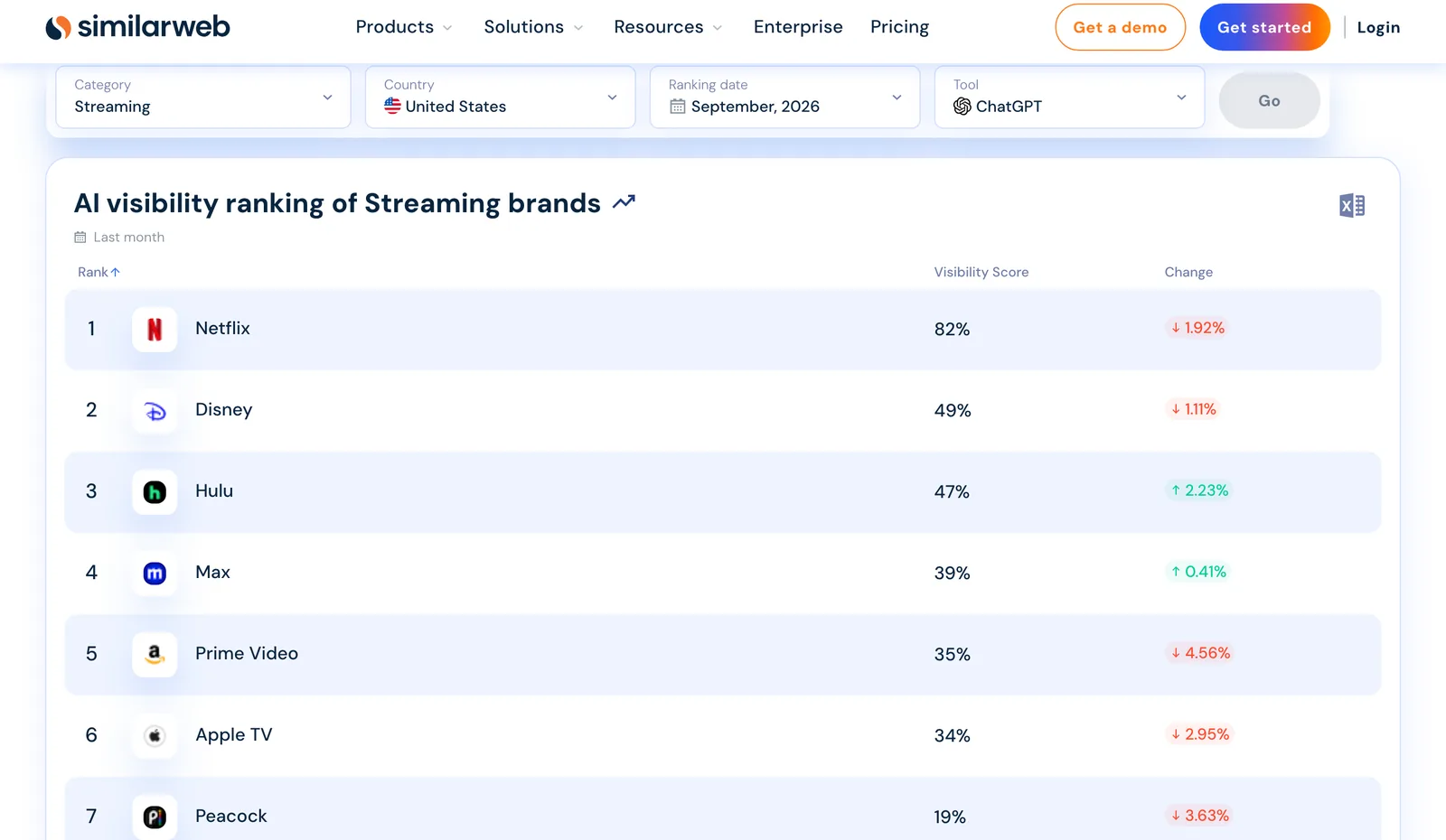
| AI Visibility Leaderboard | Similarweb | Brands by category (streaming, retail, B2B software and more) on ChatGPT, Perplexity, Gemini, AI Overviews, Grok, Claude, DeepSeek | aisearch.similarweb.com |
| AI Visibility Index | Semrush | 1,200+ brands in 22 industries on ChatGPT, Gemini, AI Mode, AI Overviews (126M prompts) | semrush.com (2026 index) |
| The AI 500 | Trakkr | 500 brands, 0 to 100 score, ChatGPT, Claude, Gemini, Perplexity | trakkr.ai/rankings |
| AI Brand Visibility Index | Parse | Brands by share of AI answers that mention them, last 30 days | parse.gl/brands |
FAQ
- Which CRM does ChatGPT recommend most?
- HubSpot. In our Aug 2026 test it was named in 95% of ChatGPT answers, then Zoho CRM (85%) and Salesforce (70%). Pipedrive was named in 60%.
- What is the best CRM according to AI?
- It depends on the engine. HubSpot leads on ChatGPT, Gemini, and Perplexity. Pipedrive and Zoho CRM follow. Salesforce ranks fourth overall, because Gemini and Perplexity name it in only 40% of answers.
- Why do some CRMs score zero?
- No engine named them in any answer we scored. That does not mean the product is bad. It means the sources the engines read do not mention them for these buyer questions.
- How is the CRM AI visibility score calculated?
- 50% how often a brand is named, 30% how often it is in the top 3, 20% how often it is named first. Score runs from 0 to 100.
Sources
- Noetio, AI Visibility Leaderboard, methodology and full rankings, updated August 2026.
- Aggarwal et al., GEO: Generative Engine Optimization, KDD 2024. Sources, quotations, and statistics raised visibility by 30 to 40%.
- Muck Rack, Generative Pulse, May 2026. 25M+ links cited by ChatGPT, Gemini and Claude; 84% earned media.
- Far & Wide, Reddit and Quora share of AI citations. Vendor adjacent analysis, directional.
The leaderboard is our own first party study. External figures come from the cited publications.
If you want this done for you