Guide
How AI chooses what to cite: what the research shows
How AI chooses what to cite can now be measured. Studies show engines rewrite your question, open a handful of pages, and cite the ones that read like a source, not a brochure. Here is what those studies found, and which popular fixes showed no effect.

Key takeaways
- 80% of AI cited URLs rank nowhere in Google's top 100, and ChatGPT and Perplexity share only 11% of their cited sources, so a strong ranking barely protects you.[4][6]
- llms.txt and schema markup show no measurable effect, while citations, quotes and statistics raised visibility up to 40% in the founding research.[3][12][13]
- Answers change on every single run, so one snapshot measurement is close to meaningless.[8][10]
In this article
In a 2026 survey of more than a thousand B2B software buyers, 51% said they now start product research with an AI chatbot more often than with Google.[1] Meanwhile 68% of Google searches already end without a single click to any website.[2]The decision gets made inside the answer, before your site ever loads. So the question is simple: when the AI answers, does it say your name, or your competitor's?
How does the engine pick a source?#
When you ask ChatGPT or Google's AI a question, it does more than recall its training data. For anything current, it runs a live search step: it rewrites your question into a few related queries, opens a handful of candidate pages, reads them, and writes an answer built from the passages it trusts, attaching citations to a small number of them. Making your page one of those cited passages is what generative engine optimization (GEO, also called AEO or AI SEO) means. Each engine has its own search backend. See how it works for ChatGPT, Perplexity and Claude.
The foundational academic work on this tested nine content changes on a benchmark of 10,000 queries drawn from 25 domains. A few tactics measurably raised how often a source got surfaced: adding citations to authoritative references, quoting experts directly, and including concrete statistics, chief among them, up to a 40% lift.[3] Engines reward content that reads like a citable source, not content that reads like a brochure. Keyword stuffing, the reflex of a decade of SEO, did not help.
Does a strong Google ranking help?#
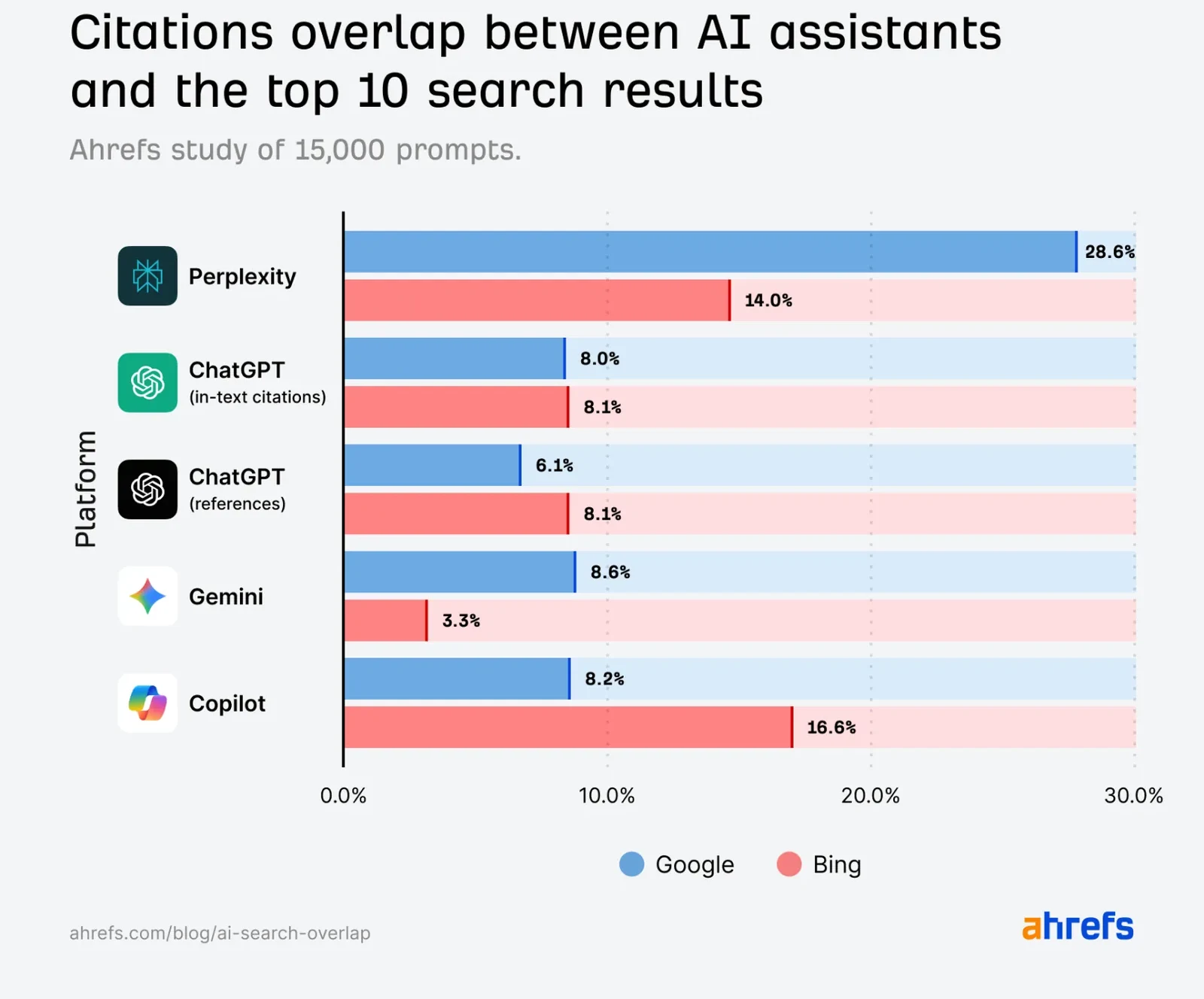
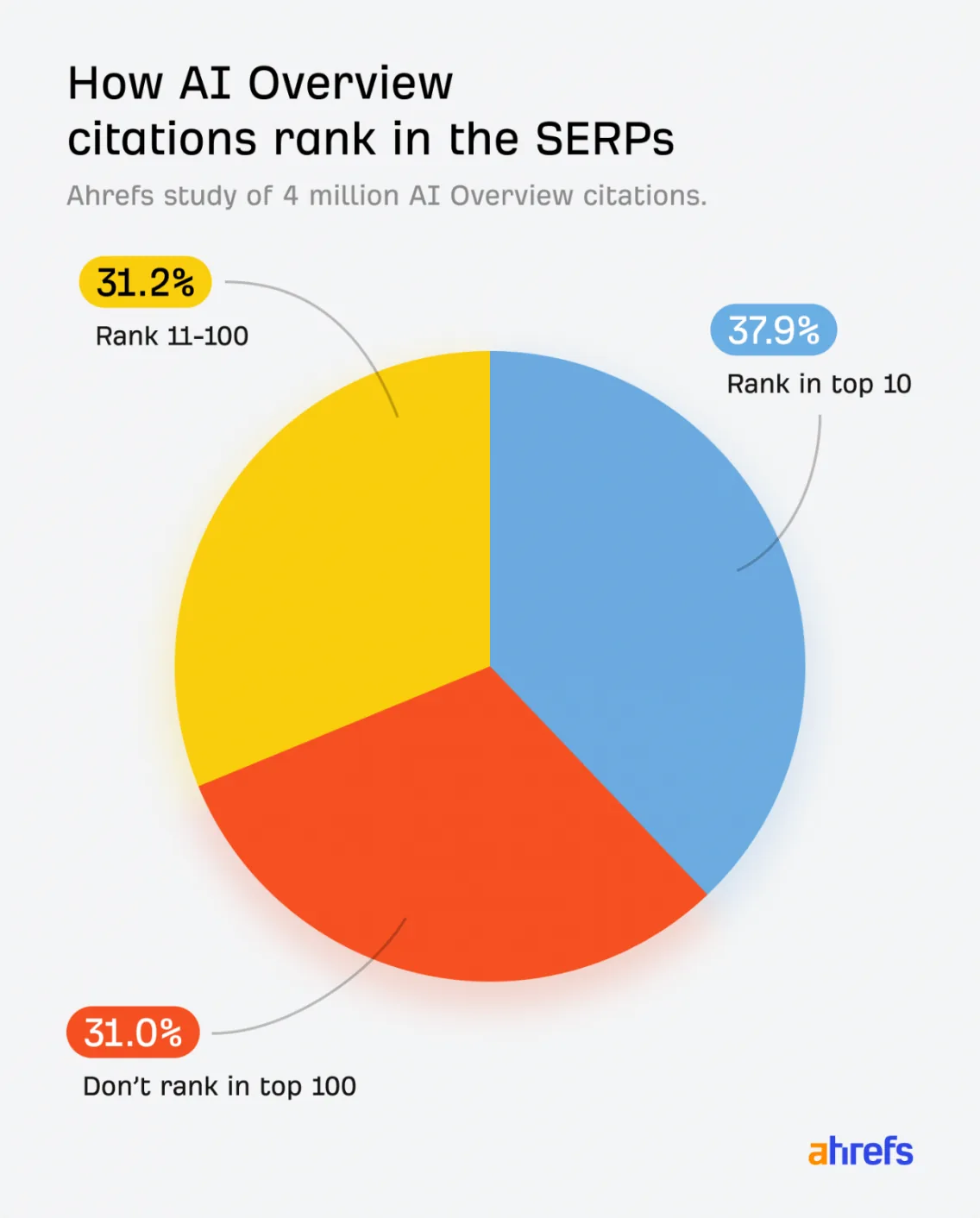
Barely, and the data is blunt about it. In an analysis of 15,000 prompts, only 12% of the URLs cited by AI answers also ranked in Google's top 10 for the query, and a full 80% did not rank anywhere in the top 100.[4] Ahrefs then tracked that overlap over time and watched it fall from about 76% in mid 2025 to roughly 38% by early 2026; a separate BrightEdge study, using a different method, put it as low as 17%.[5] A page can hold position one on Google and never appear in a single AI answer. The link between ranking and citation is weak, and it keeps getting weaker.
Is there one “AI” to optimize for?#
No. When the same 100,000 prompts ran through ChatGPT and Perplexity, the two engines shared only 11% of their cited sources, meaning about 89% of the citations came from completely different places.[6] You can be the default answer in one engine and invisible in another for the identical question. Any tool that folds engines into one blended score is averaging across worlds that barely touch.
And those worlds skew toward places most brands never invest in. A study of 78.6 million searches found that on Google's AI Overviews, YouTube and Reddit were among the most cited domains (9.5% and 7.4% of citations), while ChatGPT leaned harder on Wikipedia.[7] A plan that only publishes on your own domain misses most of these places.
The answer changes every single time you ask#
An AI answer is not a ranking you read once. It is a sample from a wide probability distribution. In one controlled test, the semantic similarity between AI responses to 142 differently phrased versions of the same question averaged just 0.081, close to unrelated text.[8] Even at temperature zero, the most deterministic setting, large language models do not reliably return the same output twice, a fact documented in peer reviewed literature.[9] Recent academic work on measuring AI visibility puts the lesson in its title: do not measure once.[10]
The consequence is expensive. A single check of “does the AI mention us” is a coin flip reported as a fact, and most dashboards report exactly that one flip. Some signals are noisier than others: one large study found a brand's sentiment in AI answers flips roughly seven times more often between runs than whether it is mentioned at all.[11] The way to report an AI visibility number is to sample each question several times per engine and show a confidence interval, then call a change confirmed only when the intervals separate. That is the basis of our own measurement, published on the methodology page.
What do the tests show works, and what does not?#
Two heavily marketed fixes have now been tested at scale. Neither showed an effect. The table sums up the results.
| Tactic | Result in the study | Source |
|---|---|---|
| Add citations, quotes, statistics | Raised how often a source was surfaced, up to 40% | Aggarwal et al. (ref 3) |
| Keyword stuffing | Did not perform well | Aggarwal et al. (ref 3) |
| llms.txt | 97% of files got zero requests (137,000 domains) | Ahrefs (ref 12) |
| JSON-LD schema | No meaningful citation lift; AI Overview citations fell 4.6% vs controls | Ahrefs (ref 13) |
Does not work: llms.txt
Vendors sell this file as a way to guide AI crawlers. In a study of 137,000 domains, 97% of llms.txt files received zero requests of any kind.[12] Nobody is reading it.
Does not work: schema markup for citations
When Ahrefs added JSON-LD to 1,885 pages and compared them against 4,000 matched controls, there was no meaningful lift in AI citations, and AI Overview citations fell 4.6% relative to the controls.[13] Keep schema for classic rich results; do not expect it to earn a citation.
What works: be fetchable
An engine cannot cite a page it cannot retrieve. Server errors, aggressive bot blocking, and content that only renders after heavy JavaScript quietly remove you from the candidate pool before the ranking even starts.
What works: show up where engines look
Citations concentrate on community and video platforms, Reddit, YouTube, LinkedIn, far more than on brand blogs.[7] See AI brand mentions and third-party citations.
What works: write like a citable source
Authoritative citations, direct quotations and concrete statistics measurably increased how often a page got surfaced.[3] Specific, dated, verifiable facts get lifted into answers; vague marketing prose does not.
Membership in the answer is durable, and so is exclusion. The same study that measured near zero wording similarity across phrasing also found leading brands showing up in 55% to 77% of responses.[8] When we scored 20 CRM brands across three search grounded engines, one brand was named in 94% of answers and seven brands appeared zero times.[14] Zero is a common score, not a rare one, and the category is young enough that most of your competitors are invisible too.
Noetio measures which sources ChatGPT, Perplexity and Google's AI Overviews cite for your category, then ships the pages and mentions the research above supports. See our AI SEO services, or run the free check.
FAQ
- How does AI choose which sources to cite?
- For current questions, engines rewrite your question into a few queries, open a handful of pages, read them, and cite a small number of passages. In the GEO benchmark, adding citations, quotes and statistics raised how often a source was surfaced, by up to 40%.
- Does ranking on Google help you get cited by AI?
- Only a little. Ahrefs found 12% of AI-cited URLs ranked in Google's top 10 for the query, and 80% did not rank in the top 100.
- Do ChatGPT and Perplexity cite the same sources?
- No. Across 100,000 identical prompts they shared only 11% of cited sources, according to Profound.
- Do llms.txt and schema markup help AI citations?
- Studies found no effect. In a study of 137,000 domains, 97% of llms.txt files got zero requests. Ahrefs found no meaningful citation lift from JSON-LD schema.
Does AI name you, or a competitor? Find out in 60 seconds.
Sources
- 51% of B2B software buyers start research with an AI chatbot more often than Google (survey of 1,076 buyers): G2, 2026 AI Search Insight Report, April 2026.
- 68% of US Google searches end without a click (January to April 2026): SparkToro with Similarweb, “Less than One Third of Google Searches Still Send a Click”, June 2026.
- Adding citations, quotations and statistics measurably raises a page's visibility in generated answers, by up to 40%; the paper reports that “simple methods like Keyword Stuffing traditionally used in SEO don't perform well” rather than that they backfire: Aggarwal et al., “GEO: Generative Engine Optimization”, arXiv:2311.09735 (KDD 2024).
- 12% of AI cited URLs rank in Google's top 10; 80% do not rank in the top 100 (15,000 prompts): Ahrefs, August 2025.
- Ranking to citation overlap decline (76% to 38%, Ahrefs longitudinal) and 17% (BrightEdge, separate methodology): Ahrefs and BrightEdge, 2025 to 2026.
- ChatGPT and Perplexity share 11.0% of cited sources; about 89% differ (100,000 prompts): Profound, July 2025.
- Most cited domains on AI Overviews (YouTube 9.5%, Reddit 7.4%) vs ChatGPT (Wikipedia led), 78.6M searches: Ahrefs, 2025. Category level ordering also reflects Noetio's own daily tracking of B2B software buyer queries.
- Semantic similarity of 0.081 across 142 same topic prompts; leading brands appeared in 55 to 77% of responses: SparkToro with Gumshoe.ai, 2026.
- LLMs are nondeterministic even at temperature zero; uncertainty can be quantified via repeated runs: Blackwell, Barry and Cohn, “Towards Reproducible LLM Evaluation”, arXiv:2410.03492, 2024 to 2025.
- The case for repeated run measurement of AI visibility: Schulte, Bleeker and Kaufmann, “Don't Measure Once: Measuring Visibility in AI Search (GEO)” , arXiv:2604.07585, 2026.
- Sentiment in AI answers flips roughly 6.7 times more often between runs than whether a brand is mentioned: Kumar, “Generative Engine Optimization at Scale”, arXiv:2606.20065, 2026.
- 97% of llms.txt files received zero requests of any kind (137,000 domains): Ahrefs, June 2026.
- JSON-LD schema showed no meaningful AI citation lift; AI Overview citations fell 4.6% vs controls (1,885 pages vs 4,000 controls): Ahrefs, May 2026.
- CRM category leaderboard, 50 search grounded responses across 3 engines, leader named in 94% of answers and seven brands at zero: Noetio, August 2026. See the study.
Industry figures are cited as published by their sources and reflect each study's methodology; where studies disagree on the same metric, we say so. Peer reviewed references are named and linked. Noetio's own figures come from daily multi engine citation tracking and are reproducible on request.
If you want this done for you