Guide
How to rank in AI Overviews: 3 things that work, backed by data
How to rank in AI Overviews comes down to three measured things: cover Google's query fan-out (the sub-questions it adds to your question), earn mentions on other sites, and write pages Google can quote. Ranking in the top 10 blue links matters less than it used to.
Key takeaways
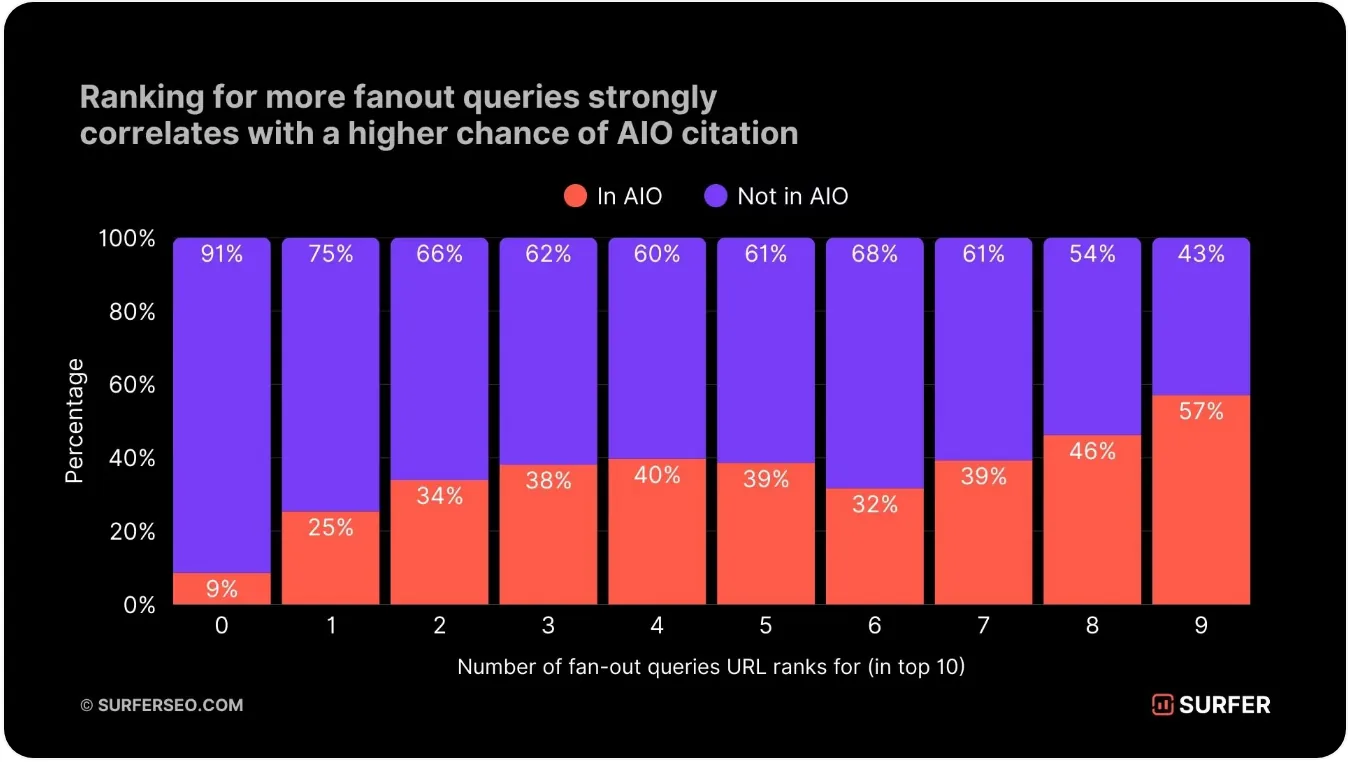
- Pages that rank for Google's query fan-out sub-questions are 161% more likely to be cited, the strongest factor measured (Spearman 0.77).[1]
- Branded web mentions correlate with visibility at 0.664, YouTube mentions at 0.740. Earned coverage beats on page tweaks.[2]
- Schema shows no measured citation lift and 97% of llms.txt files are never read. The most sold tactics have the weakest evidence.[2][7]
In this article
Which questions trigger an Overview?#
Ahrefs studied 146 million search results. 99.9% of the keywords that trigger an AI Overview are informational, not brand searches.[2]Question phrasings trigger one 57.9% of the time, “why” questions 59.8%, definitions 47.3%.[2] If your buyers ask a question before they buy, an Overview now sits above the answer, and the top ranking page gets 58% fewer clicks when one appears, across 300,000 keywords tracked.[4] The only choice left is whether the Overview names you or a competitor.
How does Google pick what it cites?#
An Overview is not built from the ten blue links you see. Google expands your question into sub-questions (query fan-out), gathers pages for each one, and writes the answer from that wider pool. Of 4 million citations Ahrefs studied across 863,000 SERPs, only 37.9% came from a page ranking in Google's top 10 for the visible query, 31.2% ranked 11 to 100, and 31.0% ranked nowhere in the top 100.[3] A year earlier the top 10 share was roughly 76%.[3] Ranking your page for the head term matters less every year. Ranking for the sub-questions matters more.
For the full picture of how AI engines choose pages, see how AI search engines work.
How to rank in AI Overviews: the 3 things that work, strongest first#
Cover the query fan-out
Pages that rank for a topic's fan-out sub-questions are 161% more likely to be cited in the Overview for the head query, Spearman 0.77, the strongest correlation measured, from a study of 10,000 keywords and 33,000 fan-out queries.[1] One pillar page chasing one term is the wrong shape. A set of pages, each fully answering one sub-question, such as the comparison, the price question, the how it works, the is it worth it, is the right shape.
Earn mentions elsewhere
Across 76.7 million Overviews for the top 50 sites, brand mentions on other pages correlate with visibility at 0.664, mentions on highly linked pages at 0.70, and mentions on YouTube, the single most cited domain in Overviews, at 0.740, the strongest brand level factor measured.[2] The review sites, comparison posts and YouTube explainers that mention you are the material the answer gets built from, not a marketing extra.
Write extractable evidence
Adding concrete statistics, quotable sentences and cited sources to otherwise identical content raised generative visibility by up to 40%, in a study of nine methods on a 10,000 query benchmark.[5] Length does not decide it: word count correlates with citation at only 0.04, and grounding quality plateaus around 540 words in a 7,000 query study.[2] Answer one question completely, with a dated number and a named source.
| Factor | Measured result | Source |
|---|---|---|
| Rank for the fan-out sub-questions | 161% more likely to be cited; Spearman 0.77 | SurferSEO (ref 1) |
| Brand mentions on YouTube | 0.740 correlation with visibility | Ahrefs (ref 2) |
| Brand mentions on other web pages | 0.664 correlation with visibility | Ahrefs (ref 2) |
| Statistics, quotes and sources on the page | Up to 40% more visible | Aggarwal et al. (ref 5) |
| Word count | 0.04 correlation with citation | Ahrefs (ref 2) |
| FAQ schema | 3.6 vs 4.2 ChatGPT citations, with and without | SE Ranking (ref 6) |
| llms.txt | 97% of files get zero requests | Ahrefs via SEJ (ref 7) |
What does not work, despite being sold hard#
Schema markup first. Pages with FAQ schema earned slightly fewer ChatGPT citations than pages without it, 3.6 versus 4.2, across 216,524 pages in 20 niches.[6]Schema appears nowhere in Ahrefs' measured Overview factors.[2] Keep it for classic rich results; expect no citation lift. llms.txt is weaker still: across 137,000 domains, 97% of llms.txt files receive zero requests at all.[7]Tactics that talk to machines about your content do not move citations. Changes to what the content says do. If an agency's Overview offer is schema plus an llms.txt file, you are buying the two tactics with the weakest evidence behind them.
Measuring whether any of it worked#
Overviews change without changelogs, and the same query does not reliably repeat. A stability study puts the floor at roughly seven repeated runs per query before a per brand estimate settles.[8] One manual check a week is noise wearing the costume of data. We sample Google Overviews and AI Mode daily, alongside ChatGPT, Perplexity and Gemini, and run every tracked query again after each shipped fix, so a citation gained or lost is tied to the change that moved it.
More on the traffic side: AI Overviews traffic loss. To check an agency's claims, read how to verify AI visibility results.
Noetio tracks which of your buyers' questions trigger an AI Overview, checks who it cites today, and ships the fixes that change the answer, then reruns the same prompts to confirm it moved. See our AI SEO services. We publish how often each question ran, and every confidence interval, in our methodology.
Want to know which of your buyers' questions trigger an AI Overview that cites a competitor instead of you? Run the free check.
FAQ
- How do I rank in AI Overviews?
- Cover the sub-questions Google adds to your question, get mentioned on other sites including YouTube, and write pages with a clear answer, a dated number and a named source. Pages that rank for the fan-out sub-questions are 161% more likely to be cited.
- Do I need to rank in the top 10 to be in an AI Overview?
- No. In an Ahrefs study of 4 million citations, 37.9% came from the top 10 for the visible query, 31.2% from ranks 11 to 100, and 31.0% from outside the top 100.
- Does schema markup help me rank in AI Overviews?
- No lift has been measured. Schema is not in Ahrefs' measured Overview factors, and pages with FAQ schema got slightly fewer ChatGPT citations (3.6 vs 4.2) in an SE Ranking study.
- What is query fan-out?
- Google splits your question into several smaller sub-questions, searches for each one, and builds the answer from all those pages.
- Which questions trigger an AI Overview?
- Mostly questions, not brand searches. 99.9% of keywords that trigger one are informational, and question phrasings trigger one 57.9% of the time.
Sources
- Pages ranking for fan-out sub-questions are 161% more likely to be cited in the AI Overview; Spearman 0.77. Study of 10,000 keywords and 33,000 Gemini-derived fan-out queries by Joshua Hardwick with SurferSEO, “Query Fan-Out Impact”, 2026; independently reported by Search Engine Land.
- 99.9% of AI Overview keywords informational; question queries trigger at 57.9%, “why” at 59.8%, definitions at 47.3%, across 146M SERPs. Brand factor correlations across 76.7M AI Overviews for the top 50 sites: branded mentions 0.664, highly linked pages 0.70, YouTube mentions 0.740; word count ~0.04; grounding plateau ~540 words (Dan Petrovic, 7,000+ queries). Schema is absent from the measured factors: Ahrefs, 2026.
- 37.9% of AI Overview citations from Google's top 10, 31.2% from 11 to 100, 31.0% outside the top 100; 4M cited URLs, 863,000 keyword SERPs, published 2 March 2026, against an earlier measurement of roughly 76% inside the top 10: Ahrefs.
- 58% lower clickthrough for the top ranking page when an AI Overview is present; 300,000 keywords, published 4 February 2026: Ahrefs.
- Adding statistics, quotations, and citations lifts generative answer visibility by up to 40% on a 10,000 query benchmark: Aggarwal et al., “GEO: Generative Engine Optimization”, arXiv:2311.09735 (KDD 2024).
- Pages with FAQ schema averaged 3.6 ChatGPT citations vs 4.2 without, across 216,524 pages on 129,000 domains in 20 niches: SE Ranking, 2026. Vendor run studies on schema conflict; no large controlled study shows a citation lift.
- 97% of llms.txt files across 137,000 domains received zero requests (server logs, May 2026); of files with traffic, 96% of requests were bots, most of them not AI crawlers: Ahrefs study, reported by Search Engine Journal, June 2026.
- Roughly seven or more repeated runs per query needed for stable AI visibility estimates: Schulte, Bleeker and Kaufmann, “Don't Measure Once: Measuring Visibility in AI Search (GEO)”, arXiv:2604.07585, 2026.
Correlation studies describe association, not causation; where a controlled experiment exists it is labeled as such. Vendor run studies are labeled with the vendor. Our own measurement methodology is published at noetio.com/methodology.
If you want this done for you