Study
AI Overviews traffic loss: what rank one is worth now
AI Overviews traffic loss is the clickthrough rate a page gives up once an AI Overview shows above it, and new data puts an exact number on it: rank one now keeps about half of what it used to. Three studies published this year measured it from different angles, clicks, zero click searches, and where the citations come from. Here is every number, with its source.

Key takeaways
- The top ranking page now loses 58% of its clicks when an AI Overview shows, up from 34.5% ten months earlier, same design.[1][2]
- 68.01% of US Google searches end with no click at all, up from 60.45% in 2024.[3]
- Only 37.9% of the URLs Google cites inside its own AI Overviews come from its own top 10.[4]
In this article
How much does an AI Overview cost the top ranking page?#
In February 2026, Ahrefs re ran its clickthrough study on 300,000 keywords and found the top ranking page now loses 58% of its clicks when an AI Overview appears above it. Ten months earlier, the same design measured 34.5%.[1][2] The loss is getting worse, not settling.
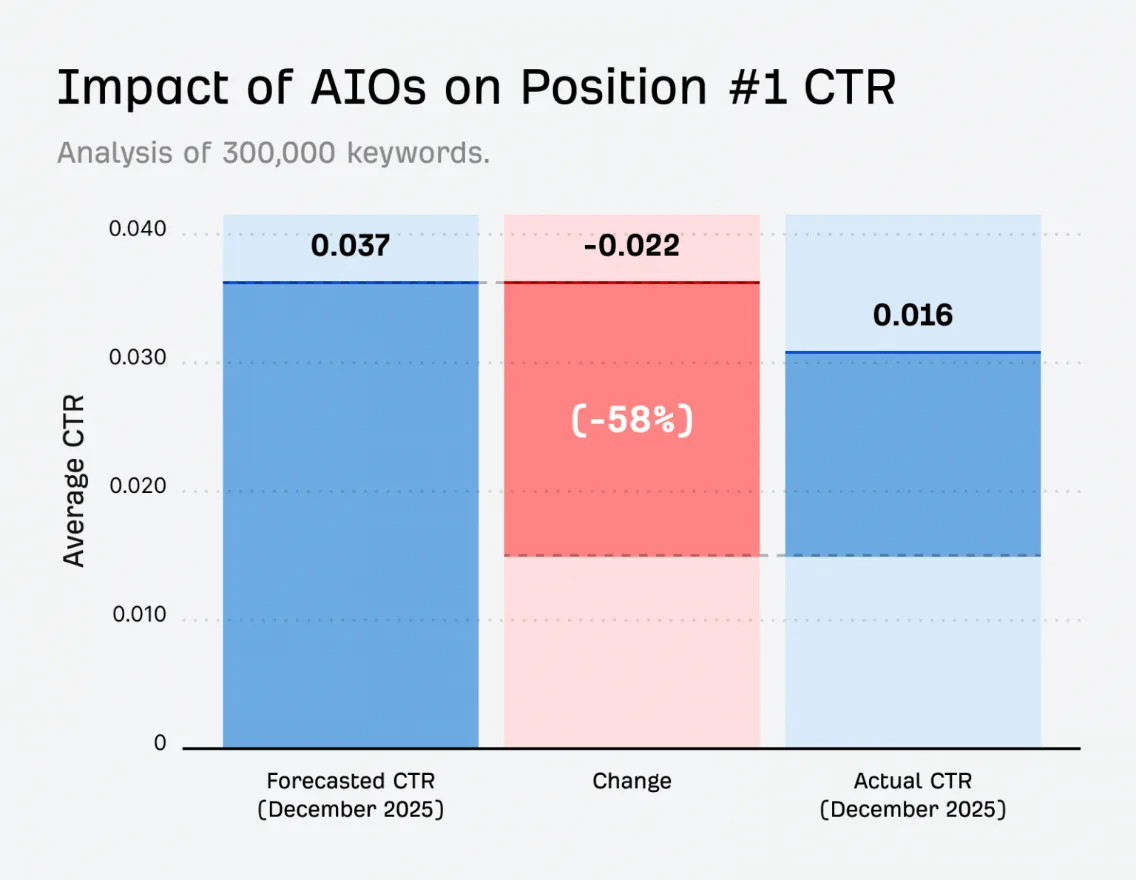
Every rank below the top spot lost too, in the same study:[1]
Both studies measure a two year gap, not a designed cause, and the authors say so. But the direction and the size agree with the earlier 34.5% reading, so this is not one bad sample.
Why do so many searches end without any click?#
SparkToro, working from Similarweb clickstream data, found that 68.01% of US Google searches ended with no click in the first four months of 2026, against 60.45% in 2024. Only 276 of every 1,000 searches now reach the open web.[3] Split by AI Overview presence, the zero click rate runs at about 83% when one shows and about 60% when it does not, and an AI Overview now appears on more than one in five searches.[3]
Does ranking harder fix it?#
In March 2026, Ahrefs traced 4 million URLs cited inside Google's own AI Overviews across 863,000 keyword searches. Only 37.9% came from Google's own top 10. 31.2% came from position 11 to 100. 31.0% ranked outside the top 100 entirely.[4] Ranking in the top 10 is the main tool normal SEO gives you, and it explains barely a third of what gets cited.
A separate, August 2025 study measured AI answers across engines with no reason to favor Google's index, including ChatGPT and Perplexity: only 12% of cited URLs ranked in Google's top 10, and 80% did not rank in the top 100 at all, across 15,000 prompts.[5] The two do not conflict. One measures Google citing itself, the friendliest case for a ranking strategy. Even there, ranking buys you a minority of the citations.
Where did the demand go instead?#
Buyers did not stop looking. G2 surveyed 1,076 B2B software buyers in March 2026: 51% now start product research in a chatbot more often than in Google, up from 29% a year earlier. 69% said a chatbot steered them to a different vendor than the one they set out to buy. One in three bought from a vendor they had never heard of before the chatbot named it.[6]
Budget is already following. Conductor surveyed more than 250 leaders at large US companies: 94% plan to spend more on answer engine optimization in 2026, and 12% of digital budget already went there in 2025. Conductor sells AEO software, so read this as what committed buyers are doing, not a market wide count.[7]
What raises a citation?#
The one designed experiment behind this field tested nine writing changes on a 10,000 query benchmark. Naming sources, adding quotable sentences and adding concrete statistics raised a page's visibility in generated answers by up to 40%.[8] Schema markup, llms.txt files and entity declarations are hygiene. Neither has controlled evidence behind it as a way to get cited.
Measurement is the hard part. Engines answer the same question differently run to run, and research on measuring AI visibility finds you need that you need roughly seven or more repeats of each question before a per brand estimate settles.[9] One check tells you close to nothing. A citation, once won, tends to stay, which is why claiming a slot early costs less than displacing an incumbent later.
Which studies measured AI Overviews traffic loss?#
| Study | Published | What it measured | Result |
|---|---|---|---|
| Ahrefs, update | Feb 2026 | Clicks at position 1 with vs without an AI Overview, 300,000 keywords | 58% fewer clicks |
| Ahrefs, original | Apr 2025 | Same design, March 2024 vs March 2025 | 34.5% fewer clicks |
| SparkToro (via Search Engine Land) | 2026 | US Google searches with no click, Similarweb clickstream | 68.01% zero-click, vs 60.45% in 2024 |
| Ahrefs, citations | Mar 2026 | Where 4 million AI Overview citations rank | 37.9% from Google's top 10 |
| Ahrefs, AI overlap | Aug 2025 | 15,000 prompts, citations across AI engines | 12% rank in the top 10 |
Want to know what to do about it? Read how to rank in AI Overviews. For the money side, see the GEO ROI and business case.
Noetio measures this for you: which questions in your category still name a competitor instead of you, checked across engines with repeated runs, not one screenshot. See our AI SEO services for how the work is scoped.
See which questions in your category name a competitor instead of you.
FAQ
- How much traffic do AI Overviews take?
- Ahrefs found the top ranking page loses 58% of its clicks when an AI Overview shows above it (300,000 keywords, December 2025). Lower ranks lose less, down to 19.4% at position 10.
- Do AI Overviews reduce organic traffic?
- Yes, in the studies we found. Ahrefs measured 34.5% fewer clicks in 2025 and 58% in 2026. SparkToro found 68.01% of US Google searches end with no click.
- What is a zero-click search?
- A search where the user does not click any result. SparkToro, using Similarweb data, found this was 68.01% of US Google searches in early 2026.
- How can I get cited in an AI Overview?
- Ranking in Google's top 10 explains only 37.9% of the URLs cited. Adding sources, quotes and concrete statistics raised visibility by up to 40% in one academic study.
Sources
- Ahrefs, “Update: AI Overviews Reduce Clicks by 58%”, published 4 February 2026. 300,000 keywords, December 2023 against December 2025. Position losses: 58% at rank 1, 50.8% at rank 2, 46.4% at rank 3, 38.8% at rank 4, 32.6% at rank 5, 19.4% at rank 10.
- Ahrefs, April 2025. The original measurement: 34.5% lower clickthrough at position 1, 300,000 keywords, March 2024 against March 2025.
- Search Engine Land, 2026, reporting SparkToro on Similarweb clickstream data. 68.01% of US Google searches ended with no click in early 2026, against 60.45% in 2024; 276 of every 1,000 searches reach the open web; about 83% zero click with an AI Overview present against about 60% without.
- Ahrefs, published 2 March 2026. 4 million cited URLs across 863,000 keyword SERPs: 37.9% from Google's top 10, 31.2% from positions 11 to 100, 31.0% from outside the top 100.
- Ahrefs, August 2025. 15,000 prompts across multiple AI engines: 12% of cited URLs rank in Google's top 10, 80% do not rank in the top 100.
- G2, “The Answer Economy”, survey of 1,076 B2B buyers, fielded March 2026. 51% start product research in a chatbot more often than Google, against 29% a year earlier; 69% were steered to a different vendor; one in three bought from a previously unknown vendor.
- Conductor, State of AEO and GEO, 2026. Survey of 250+ leaders at US organizations with 500 or more employees: 94% plan to increase AEO investment in 2026, 12% of digital budget already allocated in 2025. Conductor sells AEO software.
- Aggarwal et al., “GEO: Generative Engine Optimization”, arXiv:2311.09735, KDD 2024. 10,000 query benchmark; citations, quotable sentences and statistics raised visibility by up to 40%.
- “Don't Measure Once: Measuring Visibility in AI Search”, arXiv:2604.07585, 2026. Roughly seven or more runs per query needed before a per brand visibility estimate stabilizes.
Every figure was traced to its primary source. Where a study is run by a vendor with a commercial interest in the result, it is labelled as such in the entry below.
If you want this done for you