Study
AI brand mentions come from third-party citations
AI brand mentions mostly come from third-party citations: pages other people publish about your brand, not your own site. Across 25 million links cited by ChatGPT, Gemini and Claude, 84% are earned media. This post covers who writes about you, and what the studies show about it.

Key takeaways
- 84% of everything AI engines cite is earned media, third-party content about you. Paid placements account for 0.3%. Measured across 25 million cited links.[5]
- Branded web mentions correlate with AI visibility at r = 0.66 across 75,000 brands. Backlinks manage r = 0.22.[7]
- 61.7% of AI citations are ghost citations: your link appears, your name never does. Citations and mentions move independently and must be tracked apart.[1]
In this article
What is the difference between a citation, a mention and a third-party citation?#
Three things get called a citation, and mixing them up hides what matters. A citation is your URL in an answer's source list. A mention is your brand named in the visible text. A third party citation is an engine citing someone else's page that talks about you, and that is the main way engines meet a brand.
Semrush tracked 3,981 domain appearances across ChatGPT, Google AI Overviews, Gemini and AI Mode: 61.7% were ghost citations, linked but never named, and only 13.2% got both the link and the name.[1] Engines even split on which half they give you. Gemini named brands in 83.7% of appearances but linked only 21.4%. ChatGPT linked 87% of the time but named the brand only 20.7%.[1] A visibility score that reports one number is averaging two things that move on their own.
How do AI engines learn who you are?#
When someone asks what a brand is, the engine does not look it up in a registry. Google documents its AI answers as retrieval over its ordinary search index.[2] No major engine documents a brand database step. Whatever indexed pages say about you, added up, is your identity to the model.
Two tests show what that means. Ahrefs invented a fake luxury brand, gave it an official site with a plain denial page, then seeded the web with three detailed but fabricated third-party stories. The engines sided with the fabrications: detailed fiction beat a vague official denial, and Perplexity at one point confused the brand with Xiaomi.[3] Detail wins, and whoever supplies the detail writes your record.
Seer Interactive found the same thing auditing its own brand: one syndicated review from 2018 still surfaced in AI answers eight years later, and the engines read its copies as separate proof rather than one claim repeated.[4] Repetition across sites reads as proof to a model.
What do the studies measure?#
| Study | Sample | Finding |
|---|---|---|
| Muck Rack (ref 5) | 25M+ links, ChatGPT, Gemini, Claude | 84% earned media, 0.3% paid |
| Ahrefs (ref 7) | 75,000 brands | Branded mentions r = 0.66, backlinks r = 0.22 |
| Semrush (ref 1) | 3,981 domain appearances | 61.7% linked but never named |
| AirOps (ref 8) | 21,311 brand mentions | 85% from third-party domains |
| Semrush (ref 9) | 248,000 Reddit posts | Reddit 40.1% of cited sources, Wikipedia 26.3% |
| Stacker and Scrunch (ref 6) | 87 stories, no control group | Median +239% citations in 30 days |
84% of citations are earned media
Muck Rack classified 25 million links cited by ChatGPT, Gemini and Claude across 17 industries. 84% were earned media, 0.3% paid, and the split held across three editions over ten months.[5]
+239% after third-party distribution
Stacker placed 87 client stories with third-party publishers and measured citations 30 days before and after: a median lift of 239%. There was no control group, so treat this as strong evidence, not proof.[6]
Mentions beat backlinks three to one
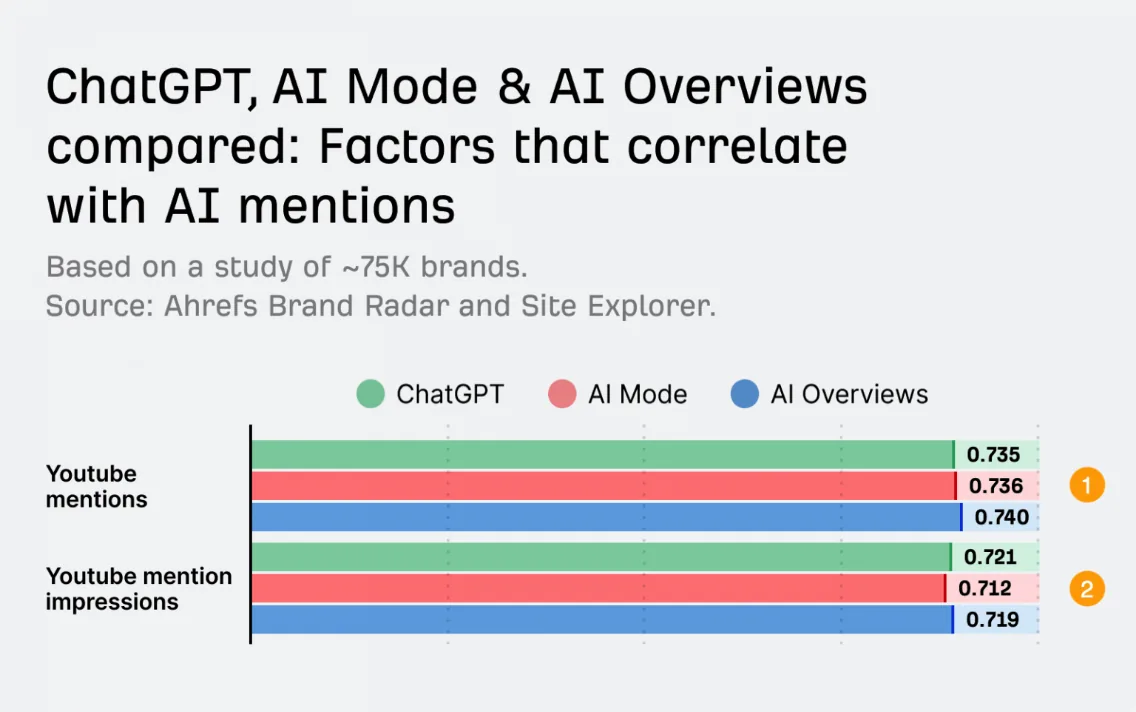
Ahrefs measured 75,000 brands: branded web mentions correlate with AI visibility at r = 0.66, backlinks at only r = 0.22. YouTube mentions correlate highest of all, at r = 0.74.[7]
Where do these mentions come from?#
Listicles and comparisons
AirOps classified 21,311 brand mentions across 500 or more commercial queries: 85% came from third-party domains, mostly listicles, comparisons and reviews, with named brands clustered in the first three discussed.[8]
Reddit
Reddit supplied 40.1% of AI cited sources in a 248,000 post Semrush analysis, ahead of Wikipedia at 26.3%.[9]
Reddit predicts recommendations
Across 112 startups, Reddit mentions were the strongest predictor of an engine recommending a company on unbranded queries, at r = +0.40, stronger than backlinks or any on page factor.[10]
What backfires, and how fast does it work?#
Writing your own roundup does not count
A study of Google AI Overviews found self published “best X” listicles get cited as the source 69% of the time while the publishing brand is left out of the actual recommendation.[11]
Seeding Reddit backfires
After engines started citing Reddit, brands seeded threads with planted recommendations. Moderators pushed back: r/Biohackers restricted new posts to weekly megathreads to stop it, and coverage called the tactic the new link farm.[12]
Recognition is fast, recommendation is not
In a monitored experiment, ChatGPT reached stable citation on a new site's branded queries by day 17, and Perplexity picked up new pages within 3 days, but 96% of that visibility stayed on branded queries.[13] Across 112 startups, ChatGPT recognized 99.4% by name but organically recommended only 3.3%, a thirty to one gap.[10]
Noetio tracks these mentions for you: which third-party pages already carry your brand, and which ones a competitor owns instead, checked across engines on a schedule. See our brand mentions service. For how each engine searches, read how AI chooses what to cite.
FAQ
- What are third-party citations in AI answers?
- An engine citing someone else's page that talks about your brand. A citation is your URL in the source list. A mention is your brand named in the visible text.
- Where do AI engines get brand mentions from?
- Mostly from pages you do not own. Muck Rack found 84% of 25 million links cited by ChatGPT, Gemini and Claude were earned media and 0.3% paid. AirOps found 85% of 21,311 brand mentions came from third-party domains.
- Do brand mentions matter more than backlinks for AI visibility?
- In Ahrefs' study of 75,000 brands, branded web mentions correlated with AI visibility at r = 0.66 against r = 0.22 for backlinks. Correlation is not proof of cause.
- Does publishing my own best-of list get me recommended?
- Not reliably. A study of Google AI Overviews found self-published best-X listicles were cited 69% of the time while the publishing brand was left out of the recommendation.
See which third-party pages already mention your brand, and which a competitor owns instead.
Sources
- Semrush, The Ghost Citations Study (with Kevin Indig), 2026. 3,981 domain appearances, 115 prompts, 14 countries. 61.7% ghost citation rate; per engine mention and citation split.
- Google Search Central, AI features optimization guide. Official documentation: AI Overviews and AI Mode use retrieval over the core search index; no knowledge graph step is documented for brands.
- Ahrefs, AI vs a made up brand, December 2025. Fictional brand, seeded fabrications against an official denial, across 8 models. Engines preferred specific fiction over vague truth.
- Seer Interactive, GEO experiment, 2026. Three months of branded prompts about their own agency; one syndicated 2018 review read as multi source corroboration by the engines.
- Muck Rack, Generative Pulse, 3rd edition, May 2026. 25M+ links cited by ChatGPT, Gemini and Claude; 84% earned media, 0.3% paid. Method disclosed, replicated across three editions.
- Stacker and Scrunch AI, March 2026. 87 stories, 30 clients, 2,600+ prompts, 8 platforms, 30 day pre and post window; median +239% citations. No control group.
- Ahrefs, AI brand visibility correlations, 2026. 75,000 brands. Branded web mentions r = 0.66, YouTube mentions r = 0.74, backlinks r = 0.22, content length r = 0.04.
- AirOps, The Influence of Offsite Signals in AI Search, 2026. 21,311 classified brand mentions, 500 or more commercial queries; 85% third-party share, listicle dominance, first three positioning.
- Semrush, Reddit AI search visibility study, 2025. 248,000 Reddit posts; Reddit 40.1% of AI cited sources against Wikipedia 26.3%.
- The Discovery Gap, arXiv 2601.00912, IIT Patna, January 2026. 112 startups, 2,240 queries; 99.4% name recognition against 3.3% organic recommendation in ChatGPT; Reddit mentions r = +0.40.
- Search Engine Land, Lily Ray AI Overviews study, 2026. 100 B2B software queries; self published listicles cited 69% of the time while the brand is left out of the recommendation.
- Search Engine Journal, Buying Reddit to win AI citations, 2026. Documented Reddit seeding operations and the r/Biohackers moderation crackdown that followed.
- Search Engine Land, fake brand AI search experiment (SE Ranking), 2026. New site monitoring: ChatGPT stable citation by day 17, Perplexity pickup in 1 to 3 days, 96% of visibility on branded queries.
Every number links to the study it came from. Vendor run datasets are labelled as such; the academic sources are arXiv preprints.
If you want this done for you