Explainer
How Perplexity search works: its own index and ranking
How Perplexity search works is public. Perplexity has published its own architecture in an engineering deep dive, launch posts, crawler docs and research articles. Every fact below links to Perplexity's own words, not a guess.

Key takeaways
- Perplexity runs its own index of over 200 billion URLs and processes tens of thousands of update requests every second.[1][2]
- Ranking runs in stages: hybrid retrieval, a cheap filter, fast rankers, then a heavier model that reads the query and your passage together.[1]
- Pages are split into self-contained pieces that are scored one at a time, so one strong section can win a citation on its own.[1][2]
In this article
How big is Perplexity's index, and how fresh?#
Perplexity builds its own index. It is not a wrapper around Google. It “tracks over 200 billion unique URLs, with capacity to track many hundreds of billions more,” and serves 200 million queries a day.[1]Freshness matters more than size. “Each second, our systems process tens of thousands of index update requests,” because “information staleness is one of the biggest failure modes for AI agents.”[2] An AI-powered parser writes custom reading logic per site.[2] A page the parser cannot read cleanly is handicapped before ranking starts.
How does Perplexity build an answer?#
Perplexity's help center describes the visible loop: interpret the question, search the web, compile findings, attach numbered citations.[3]Deep Research goes further and runs “dozens of searches” and reads “hundreds of sources” in 2 to 4 minutes.[3] Behind the loop sits a ranking pipeline with four chances to drop you.
Hybrid retrieval
The index is searched by exact words and by meaning, then merged. It favors coverage over precision.[1]
Prefilter
Stale or off-topic pages are removed cheaply, before any heavy model looks at them.[1]
Staged rankers
Fast word-match and embedding scorers narrow the set as it gets smaller.[1]
Heavier scoring
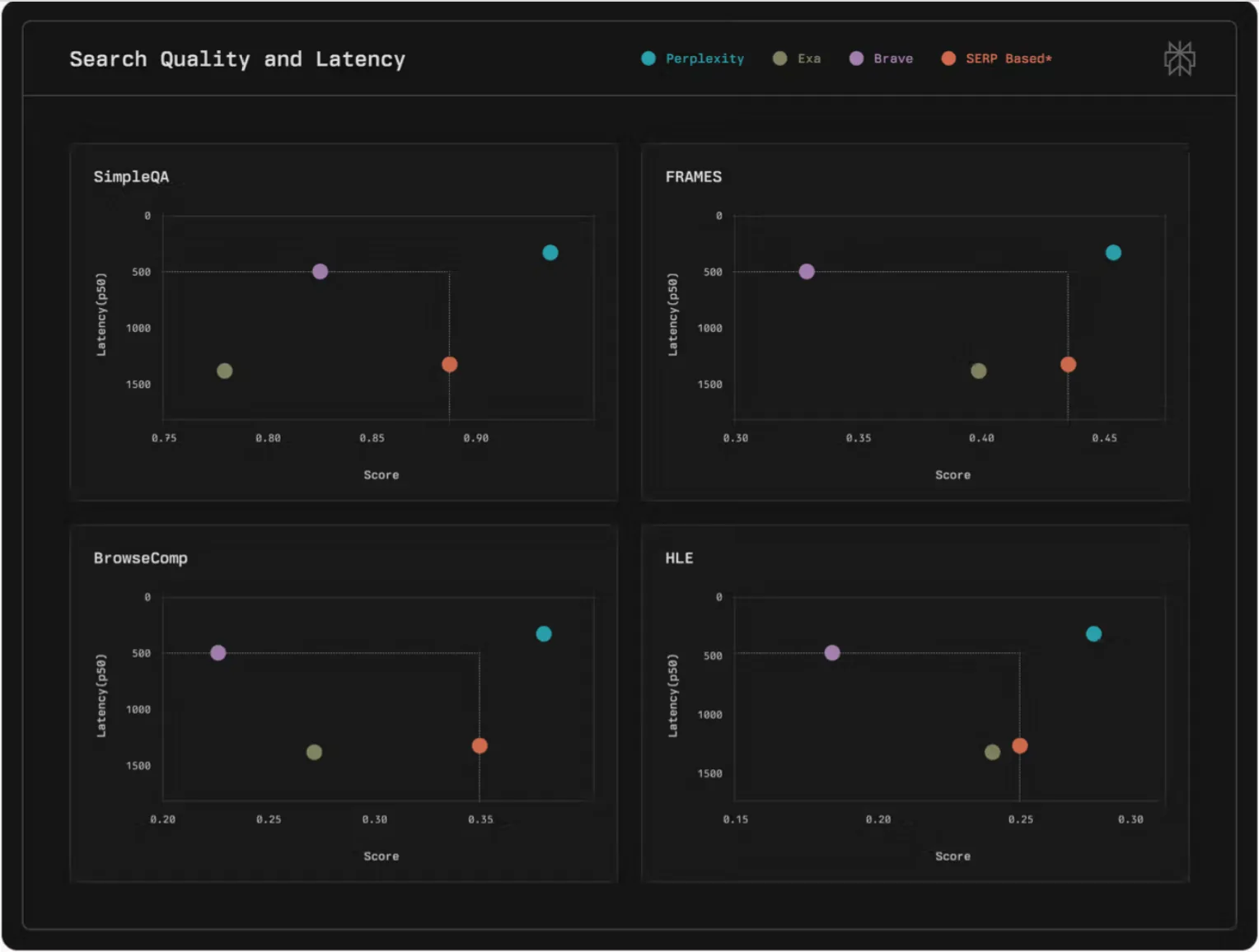
A model reads the query and your passage together for the final cut. The whole search returns in 358 milliseconds at the median.[1]
Why are pages scored in pieces?#
Perplexity's parser breaks each document into self-contained pieces, and each piece is retrieved and ranked on its own at query time.[1]The launch post says the same: sub-document units are “individually surfaced and scored against the original query.”[2] Your page does not compete as a whole. One section can win a citation while the rest is weak. A page that only makes sense read top to bottom produces pieces that all lose.
Retrieval volume keeps growing. Inside Perplexity Computer, agents already run “hundreds or even thousands of retrieval operations within a few minutes.”[5]Finance Search now sends financial questions to “licensed financial datasets, real-time market data, and cited web sources” instead of generic results.[6] Plain facts are moving to licensed data your content cannot win. What stays open is explanation, comparison and analysis worth citing.
How does Perplexity differ from ChatGPT and Claude?#
| Engine | Search backend | Search crawler (details in each post) |
|---|---|---|
| Perplexity | Its own index, 200B+ URLs[1] | PerplexityBot[4] |
| ChatGPT | Outside providers, including Bing and Shopify[9] | OAI-SearchBot |
| Claude | Not named by Anthropic. Evidence points to Brave, unconfirmed[10][11] | Claude-SearchBot |
The engines also cite different pages. Across 100,000 identical prompts, ChatGPT and Perplexity shared only 11% of their cited sources.[8] Winning in one says little about the other. For what the research says about picking sources across engines, read how AI chooses what to cite.
What does this mean for your pages?#
Let PerplexityBot in
It “is designed to surface and link websites” and “is not used to crawl content for AI foundation models.”[4] Blocking it in robots.txt removes you from the candidate pool, not from training. Many sites block it by accident.
Serve text the parser can read
Server-rendered text and clear headings parse cleanly.[1] Heavy client-side rendering can leave you crippled before ranking starts.
Make each section stand alone
Write question, direct answer, evidence in every section, since pieces are ranked alone.[1][2] Add real numbers and sources: statistics, quotes and citations raised how often a source was surfaced in the GEO research.[7]
Keep pages current
The prefilter drops stale content.[1] Update the numbers, not only the date.
Noetio checks what Perplexity says about your company and fixes the cause. See our AI SEO services.
FAQ
- Does Perplexity use Google or Bing?
- Perplexity says it builds its own search index, which tracks over 200 billion unique URLs. It is not a wrapper around Google.
- How does Perplexity choose its sources?
- It retrieves candidates by exact words and by meaning, filters out stale or off-topic pages, ranks in stages, and a heavier model makes the final cut on individual passages. Perplexity does not publish a full ranking formula.
- How fast is Perplexity search?
- Perplexity reports a median latency of 358 milliseconds for its search API.
- Should I block PerplexityBot?
- Only if you want out of Perplexity answers. Perplexity says PerplexityBot surfaces and links websites and is not used to crawl content for AI foundation models.
Does Perplexity cite you, or a competitor? Find out in 60 seconds.
Sources
- Index scale (200B+ unique URLs, 200M daily queries), hybrid retrieval, prefiltering, staged rankers, self-contained pieces (Perplexity calls them spans), 358ms median latency: Perplexity Research, “Architecting and Evaluating an AI-First Search API”, September 25, 2025.
- “Tens of thousands of index update requests” per second, staleness as a top failure mode, AI-powered content understanding, sub-document units scored individually: Perplexity, “Introducing the Perplexity Search API”, September 25, 2025.
- The four-step answer loop, numbered citations, Deep Research (“dozens of searches, reads hundreds of sources,” 2 to 4 minutes): Perplexity Help Center, “How does Perplexity work?”
- PerplexityBot surfaces and links sites, is not used for model training; Perplexity-User fetches on user request: Perplexity docs, “Perplexity crawlers”.
- “Hundreds or even thousands of retrieval operations within a few minutes”: Perplexity Research, “Rethinking Search as Code Generation”, June 1, 2026.
- Finance Search combines “licensed financial datasets, real-time market data, and cited web sources”: Perplexity, “Introducing Finance Search in the Agent API”, May 6, 2026.
- Statistics, quotations and citations raise AI visibility: Aggarwal et al., “GEO: Generative Engine Optimization”, arXiv:2311.09735 (KDD 2024).
- ChatGPT and Perplexity share 11.0% of cited sources across 100,000 prompts: Profound, July 2025.
- ChatGPT search sends queries to outside providers and names Bing (Microsoft) and Shopify: OpenAI Help Center, “ChatGPT Search”.
- Anthropic's web search documentation names no search provider: Anthropic, “Web search tool”.
- Evidence that Claude uses Brave Search, not confirmed by Anthropic: Simon Willison, March 21, 2025.
Perplexity architecture claims quote Perplexity's own posts and documentation, retrieved and verified on July 22, 2026. Study figures are cited as published and reflect each study's method.
If you want this done for you